

Why Rustin? Why Now?
The shadow of the dysfunctional New Left is so long that it’s sometimes hard to see the light beyond it.


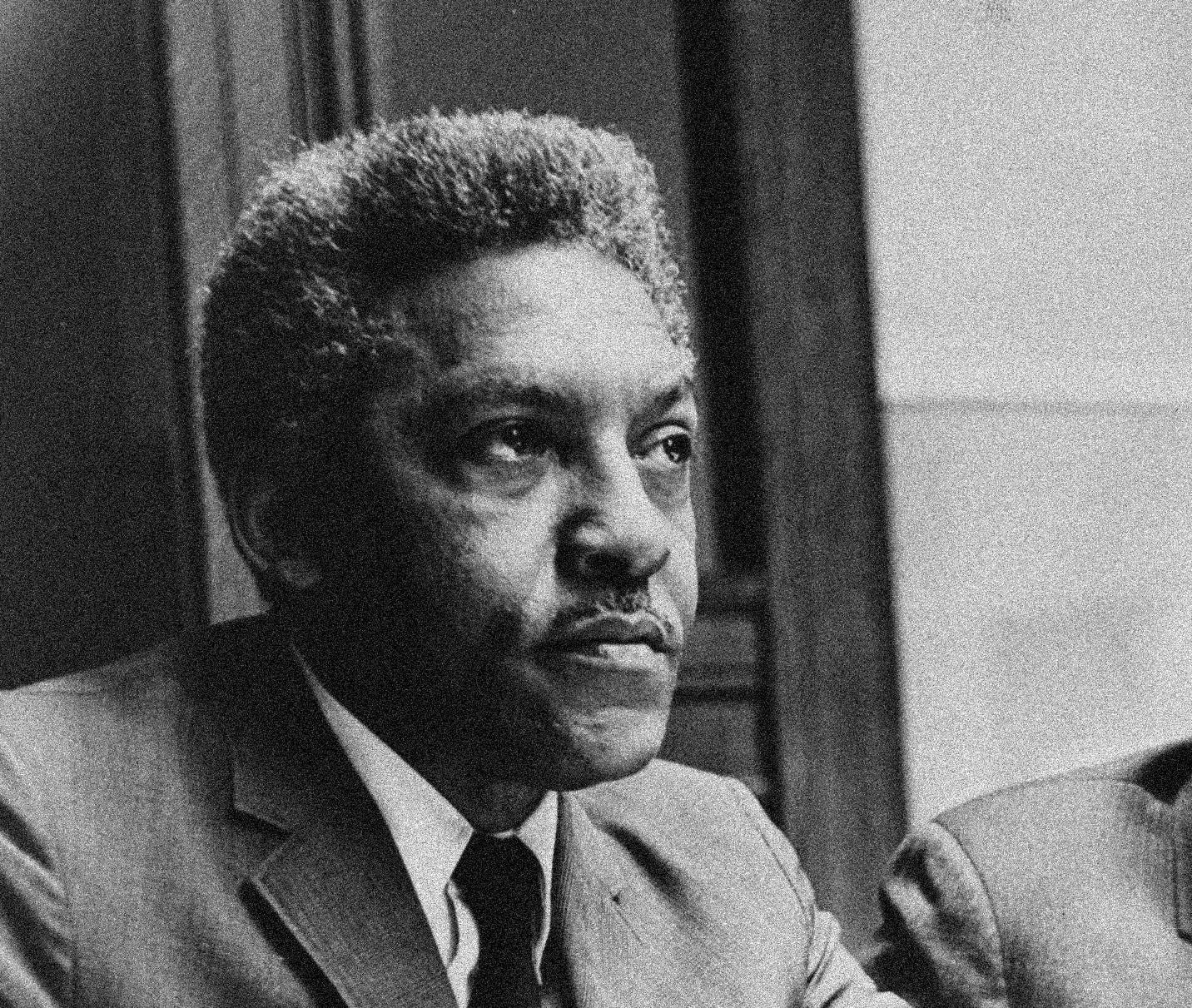
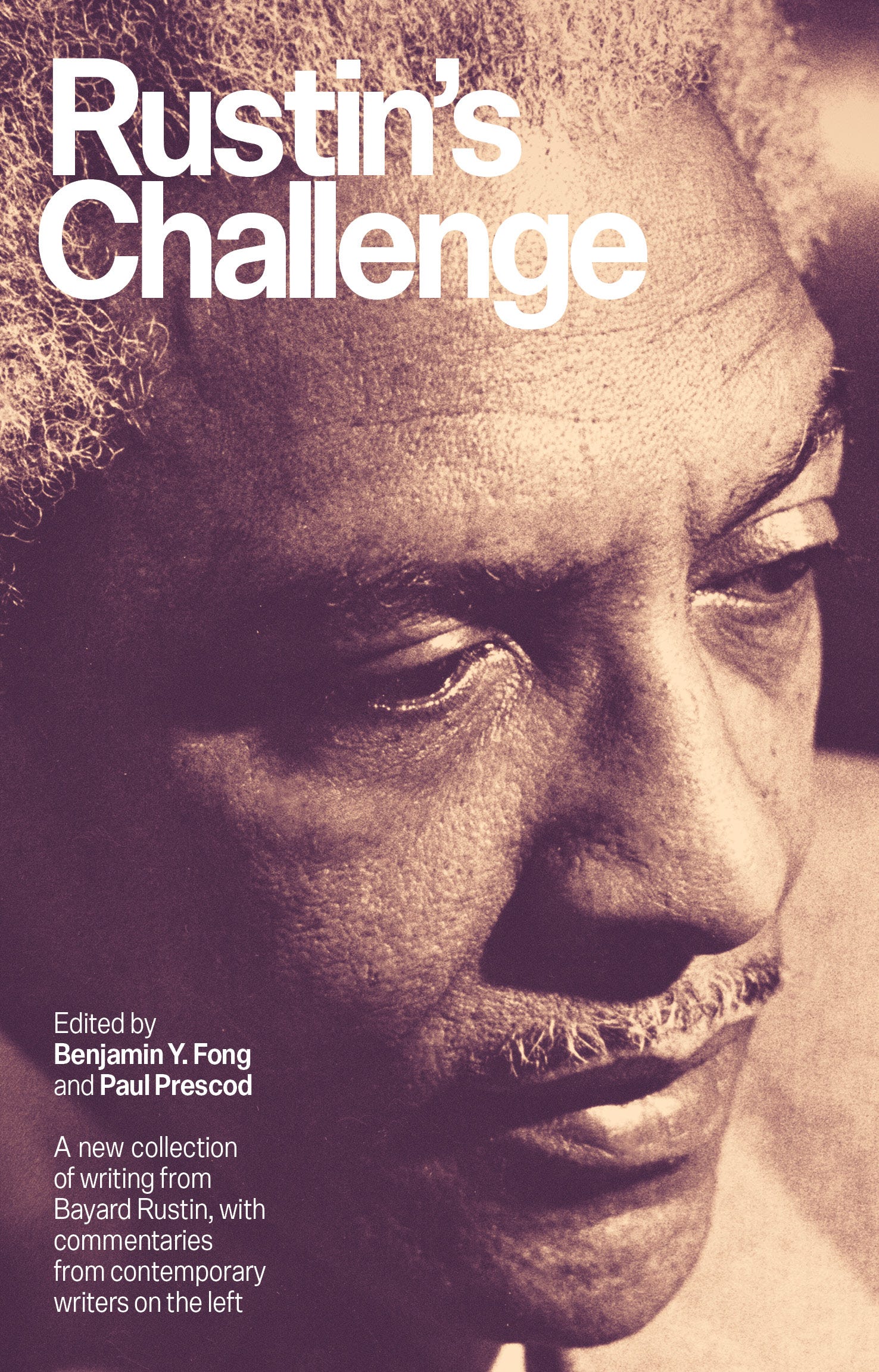
The following is adapted from opening remarks delivered at the launch for our first book, Rustin’s Challenge, in Philly on February 26, 2026. You can order Rustin’s Challenge here.
It’s easy to flatten Bayard Rustin into a kind of stock character: the 1960s activist, the outsider, the agitator, the dreamy idealist. This is wrong.
Rustin was hard-nosed and iron-willed. He was suspicious of the young New Left—and they were suspicious of him. He didn’t like sentimental liberalism. He didn’t like fads. He was, throughout his life, obsessively concerned with one problem: the problem of social class, or the problem of who gets what, and who does what, in a rich, industrial society.
Even his commitment to civil rights (for which he was immortalized most recently in a 2023 Netflix movie produced by the Obamas) wasn’t an end in itself, but rather, was a means to building what he really wanted: a movement for economic equality and social solidarity.
So one answer to the question “Why Rustin?” is simply that it’s important to set the record straight, to rescue the Rustin that we know from his writings and speeches from the risk of caricature. In an age where a person’s legacy is easily reduced to a twenty second TikTok (“Bayard Rustin: the Gay, Black Civil Rights Icon You’ve Never Heard Of!”), we want to offer people something more to chew on, some of Rustin’s actual ideas, which not only remain relevant today, but also run against the contemporary progressive orthodoxy around questions of race, identity, and political strategy.
That brings us to the second part of the question: Why now?
Coming of age in the 1930s Rustin’s political sensibilities were shaped by the organizations and philosophy of what we now call the Old Left. That Left was characterized by a singular focus on the plight of the working masses, the failures of the economic system, and the determination to forge a new social compact. He swam among the reformers and radicals of the 1940s and the civil rights change-makers of the 1950s. He was, therefore, exceptionally well-positioned to see both the virtues of the New Deal, which he fought to advance, and the emerging vices of the New Left.
The new progressives of the ‘60s, he observed, were increasingly quick to “substitute self-expression for politics.” They embraced personal autonomy as the highest good and endorsed a permanent revolution in cultural norms. They were obsessed with the psychological problems of racism and sexism but less excited by questions of how an economy should be run, the way a national budget should be organized, what to do about jobs, and who would pay for which programs and why. We still live in the long shadow of that Left; the shadow of 1968. And this shadow is now so long it’s sometimes hard to see the edges of it, or the light beyond it.
Today progressives still focus the lion’s share of their energy on cultural priorities, demands for tolerance, and radical-sounding slogans—to defund this or abolish that—which have no hope of attracting the kind of durable majorities needed to achieve reform.
Rustin witnessed the emergence of these progressive pathologies firsthand. Just as one can identify the exact moment when a bell is struck but can never quite pinpoint when the ringing stops, the counterproductive tendencies that would shape the Left for the next several decades were perfectly clear to him then. They were new and sharp, representing a break from what had come before. And, he feared, this approach to politics was a step backward that would only contribute to the slowing, or even reversal, of American political progress.
His diagnoses were prescient. In the 1970s, Rustin castigated comfortable professional-class liberals who, armed with a sense of moral superiority, attacked working-class whites as “privileged.” He predicted the rise of the urban riots that bubbled up across the United States in the late ‘60s and ‘70s, noting that those at the bottom of society were trapped in a “cycle of frustration.” He feared that demands to overturn everything, injunctions to violence, and slogans meant to scandalize, no matter how emotionally appealing, would succeed in changing nothing. Today—when protests bloom overnight on social media, demand the world, then recede just as quickly as they materialized—his criticisms are just as apt.
Or consider Rustin’s charge that liberals’ fixation on race and racism would lead them down blind alleys. “I’ll bet you there is not a class on this campus that hasn’t discussed racism,” he said in a 1971 speech at Clark College. Yet, as he pointed out, such widespread attention to racism had failed to dent inequality, and worse, it had served to obscure more basic economic problems. “If I took every black in Chicago, in Detroit, in Philadelphia, in Washington and in Atlanta between the ages of 18 and 25 and turned them white tomorrow, they still will not get jobs,” he growled. “We get such a kick out of calling people racists,” Rustin argued, that “Stokely [Carmichael] can come back to the United States and receive $2,500 a lecture for telling white people how they stink.”
Here, not much has changed except the lecture fees: today Robin Di Angelo charges $30,000 to tell white people how they stink.
But Rustin’s criticisms are only half of his genius, and they are only potent because they were complemented by clear-eyed political solutions. While Rustin relentlessly assailed what would become the defining political style of the Left, he also offered a robust political program intended to address the economic fact that has come to define our age: that the American economy was making an entire class of workers functionally redundant.
By the 1970s, Rustin had warned that advances in technology and automation, combined with the growing frenzy for free trade, would lead to mass unemployment and general wage stagnation. No amount of retraining or skill-upgrading could keep pace with the rapid changes in robotics and computerization—or the lure of cheap wages abroad. He feared the growth of a permanent underclass of workers who would never again make a decent living on their ability to sell their muscle power alone.
Since then, of course, we’ve swapped some seven million factory jobs for some seven hundred billionaires. And now, with the rise of AI, the threat of wage stagnation and widespread redundancies has returned; this time for college-educated workers. Rustin was right: no amount of skill upgrading could outrun the machines. The most straightforward solution, therefore, was massive investment in the kind of public works programs that had revitalized the American workforce a generation prior:
In World War Il, we did not ask whether people were too black, or too old, or too young, or too stupid to work. We simply said to them this is a hammer, this is a tool, this is a drill. We built factories and sent these people into the factories. We paid them extraordinarily good wages and in two months they created the miracle of making planes that flew. We can find a peacetime method for doing this—public works for schools, hospitals, psychiatric clinics, new modes of transportation, of cleaning the air, of cleaning the rivers. All of these improvements would benefit not only the poor but also the affluent.
That’s a stirring vision and today it’s even more desperately needed. As we stare down yawning inequality, a jobs crisis, and a crumbling built environment, it should be apparent that we need big new investments fast. Further, it’s obvious that the private sector has no interest in sinking billions of dollars into ensuring that working people have a decent wage, cheap electricity, tidy schools with well-paid teachers, safe neighborhoods with helpful police, and charming parks with public pools. In fact, Silicon Valley and Wall Street are far more interested in dumping billions into the very technologies that will throw countless families into chaos as they intend to slash their costs through wage depression and rolling bouts of layoffs. It’s high time we meet the challenge Rustin put to his contemporaries and reclaim his vision for the future.
Dustin Guastella is Director of Operations for Teamsters Local 623 in Philadelphia and a Board Member of the Center for Working-Class Politics.
By the time I became politically involved in the late 1960s, the old left did not exist except in the form of various Trotskyist groups and a few others like Rustin and Michael Harrington. For my generation, there was only the New Left and there was one defining issue that separated us from the liberal left and that was Vietnam. Harrington didn't come out against the war until 1968 and he spent more time criticizing the antiwar movement than he did the war itself. Ruskin, however, never came out against the war. The tragedies of the 60's left, and there were many, stemmed, in part, from the demise of a broad based, non-communist, socialist left after WW2 and the failure of Ruskin and others to recognize the one issue that would tear the nation asunder. I make no apologies for my ideological shortcomings in the 1970s. We were all young, floundering, and looking for answers. We didn't find Rustin, but Rustin didn't find us either.