

The Truth About Bayard Rustin and the Vietnam War
The lies and obfuscations repeated to this day about Bayard Rustin’s position on the Vietnam War help conveniently dismiss one of the most trenchant critics of the New Left.


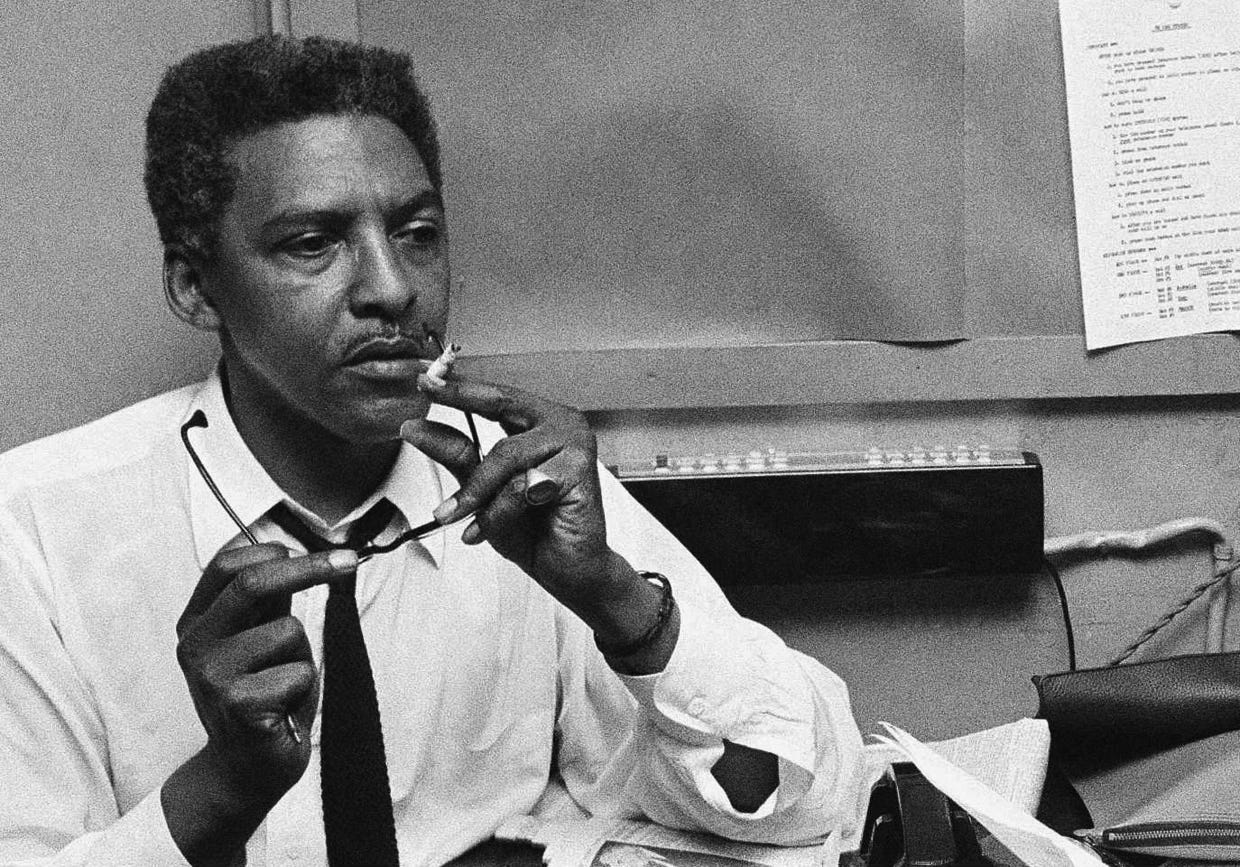
The common view of Bayard Rustin on the Left is that he was a talented and marginalized organizer in the iconic period of the Civil Rights movement, that he pulled off one of the great American political events in the March on Washington for Jobs and Freedom in August 1963, and that from the mid-1960s on, he moved to the right, tragically compromised by, amongst other things, his support for Lyndon Johnson’s war effort. The idea that Rustin either supported or did not speak out against the Vietnam War is typically employed to dismiss much of what Rustin wrote and did from the mid-60s. Indeed, I would say that this has been the main impediment to engagement with the volume that Paul Prescod and I recently published with this outfit.
To cut to the chase, this idea—again, the thing that Rustin detractors point to in order to dismiss his post-1963 work and views—is demonstrably false. I am not simply attempting to “complicate” or “unsettle” some pre-existing narrative here; I mean that the notion that Rustin supported the war is a straightforward untruth, spread first by New Leftists but repeated ad nauseam today, deployed to dismiss someone who had more organizing skill and strategic prowess in his little finger than most compile in their entire lifetimes.
About whether or not Bayard Rustin was too wedded to the political possibilities of the Johnson administration, a debate can be had. About whether or not he supported the war, it cannot. Whenever he was asked about the war, he repeated that “as a pacifist, I consider all wars evil.” In the spring of 1967, when King came out against the war, Rustin urged publicly that the conflict in Vietnam “be brought to a speedy end.”
Perhaps my favorite example of the wild disconnect between the reality of Rustin’s views and their caricature by New Leftists comes from June 1965, the month that Staughton Lynd published a scathing article on Rustin in the peace magazine Liberation, on whose editorial board Rustin sat. Lynd accused Rustin of being both a “labor lieutenant of capitalism” and also of advocating a “coalition with the marines” for his stance that leftists ought to attempt politically to seize the apparatus of the Democratic Party. It was the equivalent of declaring all-out war on Rustin as an enemy of the peace movement and of the Left more generally. As Rustin’s biographer John D’Emilio notes, Lynd’s article “displayed all the characteristics of a slash-and-burn, take-no-prisoners style of leftist debate”, which “anticipated a style of rhetorical excess soon to become commonplace among radicals.”
But what was Rustin doing in the same month of the same year that Lynd was lighting up the pages of Liberation? Here are a few lines from a speech he delivered at an anti-Vietnam War rally at Madison Square Garden in June 1965:
Though Congress refuses to admit it, we are at war. It is a useless, destructive, disgusting war. We must end the war in Viet Nam. It harms people on both sides. It reveals the bankruptcy of America’s foreign policy. The bombings, the torture, the harassment and needless killings are abhorent to me, and to all civilized men. Therefore, I am for supporting any and every proposal that is humane and relevant, that will end the war in Viet Nam.
And after this address, Rustin led the crowd in attendance in a march from MSG to the UN, where he again spoke to denounce US foreign policy.
All of this should raise a pressing question for us. How, despite expressing his opposition to the Vietnam War in both word and deed, did Rustin come to be known as someone who did not speak out against the war, and even someone who supported it?
There are a whole host of particular infractions New Leftists have cited to impugn Rustin’s character, but when it comes to the war, two key concrete particulars stand out. The first is simply that he was critical of new tactics and gestures coming from the anti-war movement. He found the burning of American flags and draft cards, as well as openly hoping for a Viet Cong victory, to be strategically objectionable, and something long-term that would turn the American public away from the peace cause.
Peaceniks of course blamed Rustin’s new ties and commitments for his having abandoned the cause, but as D’Emilio rightly claims, “Neither Rustin’s financial dependence on organized labor nor his desire to work with the Democratic Party can explain his distance from the growing antiwar movement.” Just as he had no time for the “exaggerated masculinity” of Black Power, so too did he reject the dramatic actions of the young college activists who were now the peace movement’s vanguard. As with the Black Power advocates, Rustin believed that “those in the peace movement who reject America with hate, and support conservative putchism and elitism” were in “unconscious coalition with the worst and most reactionary elements in this country.” “As soon as the Vietnam War was over, and with it the threat of conscription,” Rustin predicted, “the students would go quietly back to their studies and from there to their comfortable middle class lives.”
One can disagree with this analysis, of course, but to say that his criticism of new developments in the anti-war movement amounted to support or acceptance of the war is absurd, especially since Rustin was critical of the strategies of the anti-war movement in the name of the peace cause. But that he offered criticism at all is today used to smear him as an imperialist. I don’t think I need to spell out how this “If you’re not in agreement with us, you’re in agreement with them” kneejerk attitude continues to exist on the Left today.
However, the more substantive reason that Rustin is said to have been silent on the war concerns the rollout of the Freedom Budget. The Freedom Budget was a proposal drafted by the A. Philip Randolph Institute in 1966 for the elimination of poverty in the United States, with massive federal investments in jobs programs, healthcare, housing, education, and other sectors. As one might expect, it bore a hefty price tag, and the question of how the government would pay for such an ambitious program during wartime was naturally raised. Rustin’s position was simply that war expenditure was no impediment to carrying out a massive domestic spending program, or, more specifically, that ending the war in Vietnam was not an economic precondition of creating a more egalitarian society at home.
For this, he was excoriated from many angles. Economist Seymour Melman concluded that the Freedom Budget was a “war budget.” Stokely Carmichael agreed: “To ask for part of the Freedom Budget is to ask for the continuance of the war in Vietnam.” SDS’s Michael Kazin said it was “welfarism at home and imperialism abroad.” Rustin had not supported the war, but he might as well have, according to the critics, given his capitulation to the notion that the country could have both guns and butter.
Again, there are legitimate questions here about the relation between domestic and foreign affairs. But Rustin’s economic assertion that the war expenditure did not financially preclude a robust domestic investment program is simply not tantamount to support for the war. Outside of the contentious political mood of the 1960s, I have real difficulty dismissing the essential truth of the assertion, and wonder if anyone today would say, for instance, that we cannot restore Medicaid funding without first ending the war in Iran.
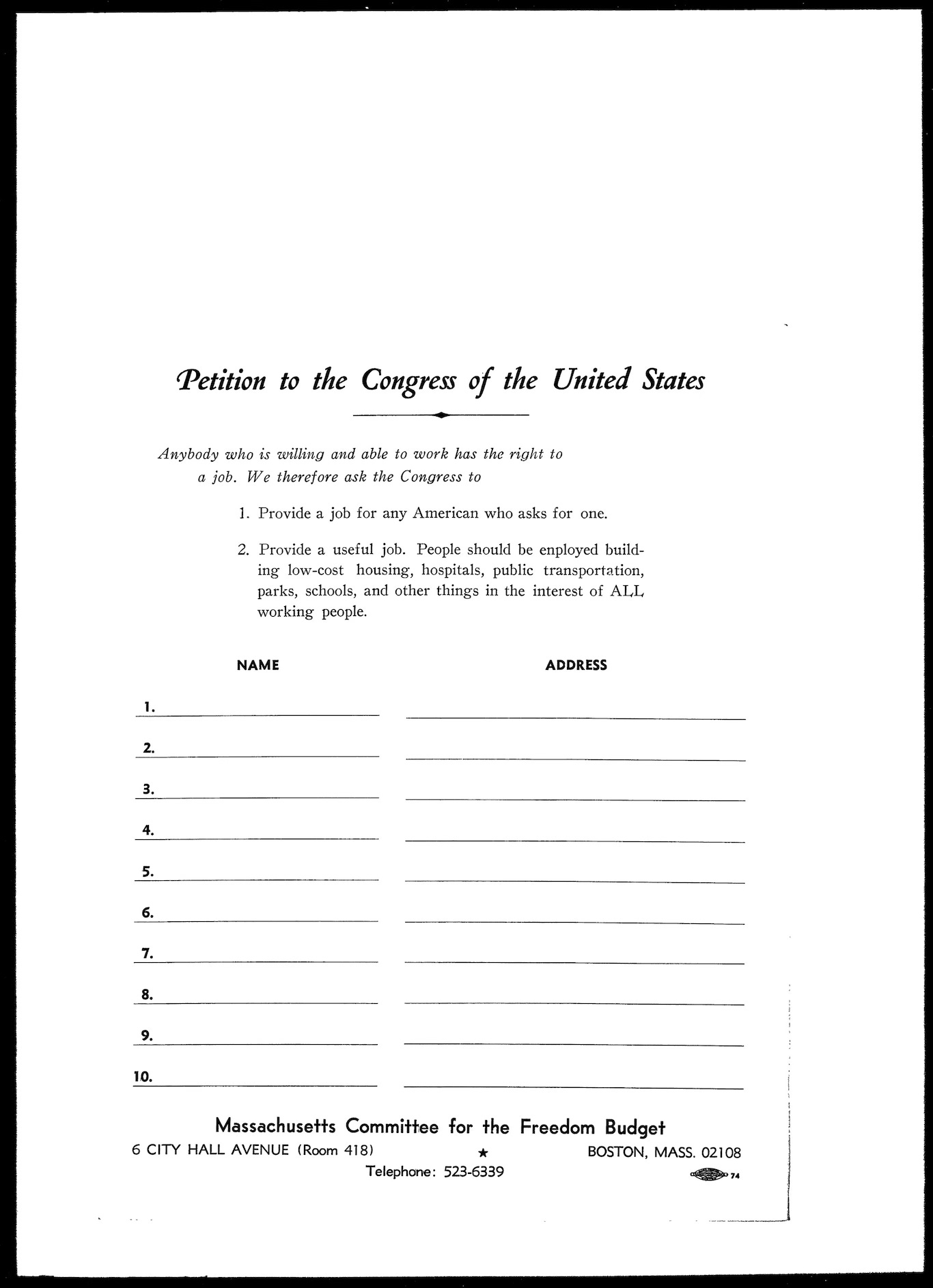
More importantly, however, Rustin thought that winning people over to a robust social-democratic program was itself a form of anti-war activism, and indeed, the form needed not just for moral condemnation of the war but for weakening its structural causes. There are two key components to this thought: first, Rustin had organized Freedom Budget chapters around the country and imagined them going door-to-door with petitions (something that never materialized in any substantial fashion, due, amongst other things, to the resistance of the New Left). His first strategic question here was: when you are knocking doors with Freedom Budget petitions, and you find someone who supports your aim of good jobs for all, do you first make sure they are against the war before you allow them to sign? If not, then why make ending the war in Vietnam a precondition of supporting the Freedom Budget?
But just as important to this strategy was the second component, which was that winning the public over to a transformative domestic program would undermine the structural drivers of the war in the long-term. To his New Left critics, he thus relentlessly emphasized the economic aspect of the problem of war: what black Americans needed, what the trade unions needed, indeed what the United States as a whole needed, was an economic replacement for the Vietnam war. It was easy to be against the war but much more difficult “to present a meaningful political alternative to expanded and increased defense spending.” To play with William James’s well-known call for a moral equivalent of war, one might say that the Freedom Budget was proposed as the economic equivalent of war: in Rustin’s words, “The most effective method of redirecting our economic energies away from the war in Viet Nam is to mobilize people around the needs of the poor and the priorities of the Freedom Budget.”
To the young “radicals,” Rustin’s message was clear: if you want the end of this war and to weaken the economic drivers that will lead to future wars, the Freedom Budget is the answer. “At some point, the Viet Nam war will be over, and unless the concepts expressed in the Freedom Budget are accepted, then the funds which will become available will be diverted to other objectives—such as sending rockets to Venus—rather than to alleviating the social conditions of the poor,” he warned. Unfortunately those rockets are still flying, and most have not left the atmosphere.
In sum, when critics bring up Rustin’s views on Vietnam, they do so to discredit him and in turn to dismiss the prophetic elements in his speeches and writings as too entangled in moral and political cowardice and confusion to take seriously. But what I think Rustin’s actual perspective on the war demonstrates is less something about Rustin himself than about a New Left eager to uphold its own moral coherence by engaging in character assassination and straightforward slander while simultaneously flouting a broad-based economic program for working-class progress. Which is to say, again, that Rustin’s work reflects back to us the continued degradation of left politics in the US, even in its very dismissal.
Benjamin Y. Fong is the co-editor of Rustin’s Challenge and keeps a Substack on labor and logistics at ontheseams.substack.com.
Peaceniks? Good lord, you sound like a Goldwater Republican. And Ruskin, a board member and activist in the War Resisters League, was himself a peacenik. His opposition to the war stemmed from his devotion to Gandhian principles. The problem with pacifism is that it treats all wars as identical, and, by itself, it tells us nothing about a particular war. However, you can be a pacifist and still have a broader understanding of the causality of war. WRL activists typically blended their opposition to all war with a specific critique of the wars in southeast Asia. That didn’t seem to be the case with Ruskin. His lack of involvement with WRL in the late 60s was indicative of where his priorities laid, and those priorities did not include serious engagement with the anti-war movement. To suggest otherwise is disingenuous. I contend that was a serious mistake on his part, and the anti-war movement would have benefited from his counsel.
However, my main beef with this essay and the previous one by Guastella is not their defense of Ruskin, which is laudable, but their ridiculous attacks on the New Left. Exactly what parts of the New Left are we talking about? Be specific. The New Left was multitudinous; the old left was not. The latter could largely be divided into three parts: the tattered remnants of the Socialist Party and its offspring, what was left of the CP, and several varieties of Trotskyism. I could not help from laughing as the author blamed Ruskin’s inability to gather signatures for his petition on New Left activism. Seriously? The reason Ruskin couldn’t get his petitions signed is because he lacked cadre. He lacked cadre because he had no organization behind him and could not generate interest in the project. By the 1960s, the old left was largely confined to NYC and a few other metropolitan areas whereas the New Left was everywhere. My politically active days in the early 1970s were spent in Tallahassee and Tampa (hardly bastions of radicalism), and there was no lack of New Left tendencies to choose from. I gravitated to the anarchists at first and later Maoism. I ended up a socialist with libertarian tendencies, more Orwellist than Marxist. To find the old left in Florida in those days you would have had to venture down to the Jewish retirement enclaves in South Beach. (I'm only half joking.)
The New Left sprang from hundreds of seemingly spontaneous uprisings, and it persisted long past the tumultuous sixties. It was born in a political vacuum and bore the scars of a political orphan. It was chaotic, ideologically incoherent, and directionless. It was, though, the only Revolution in town.