


In the fourth season of the popular TV show Couples Therapy, celebrity therapist Orna Guralnik explains her theory of mind over inspiring orchestral music set to B-roll footage of New York City and images of trains tunneling through mountainsides. She narrates:
A traditional psychoanalyst would say, “If you go deep, deep, deep, deep, deep into the unconscious, you’ll find the drives—sexual drives, aggressive drives, competitive drives, death drive… that’s the bedrock of the psyche. People like myself think that if you go really, really deep, if you dive into the unconscious, I think you’ll find the collective.
The music intensifies. Images of people from different ethnic groups appear, presumably engaged in culturally significant activities. Finally we see archival footage of immigrants arriving at Ellis Island and the 1963 March on Washington, followed by a Black Lives Matter protest. Guralnik continues, “Being part of a group and part of a collective is deeply embedded in us.”
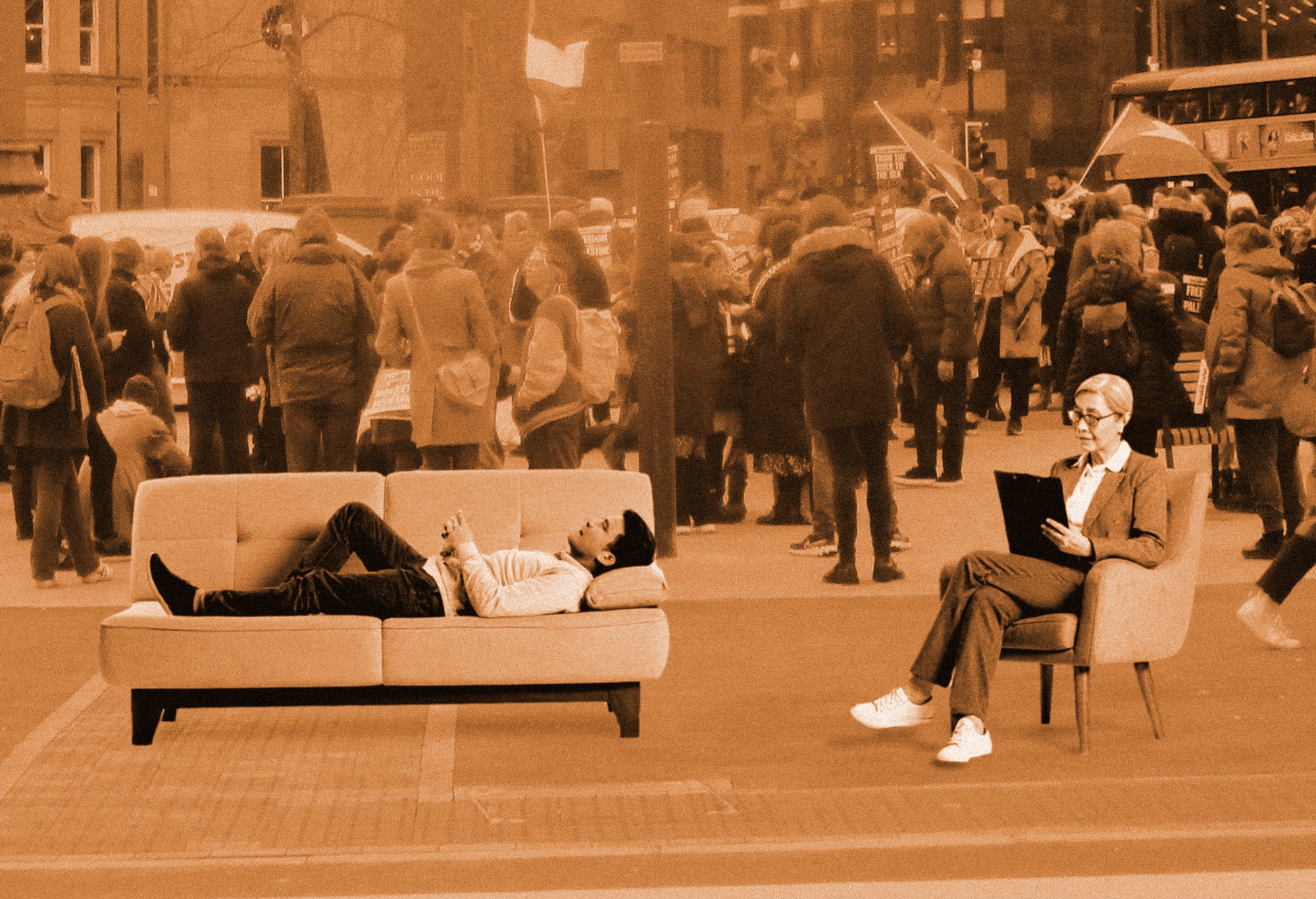
The idea that people are products of their social environment, that they desire and in fact need to be in association with one another, is not original. Freud himself famously authored several significant works on the subject, and the field’s history is rich with further elaborations in this vein. Nevertheless, according to many contemporary theorists and practitioners, psychoanalysis has a problem here. The traditional one-on-one clinical encounter in which the depths of the unconscious are probed, casting light on forbidden sexual and aggressive wishes and the defenses that prevent them from reaching consciousness, has come up woefully short in recent years by ignoring the critical role that social forces play in individuals’ lives. Worse yet, psychoanalysts have actively catered their efforts towards a particular population, disproportionately white and affluent, while claiming the mantle of universalism.
A new crop of psychoanalysts have arrived on the scene to address this deficiency. Their mandate is twofold: on the one hand, they propose a theoretical revision to correct the supposed lack of attention psychoanalysis has historically shown towards considering social facts, and to define the specific mechanisms by which the social is embedded in the psyche. On the other, they propose a number of technical interventions to address the social context in the clinical setting, both for the sake of those currently practicing and in treatment, and as part of an effort to broaden the appeal of psychoanalysis beyond its typical supply of wealthy, white practitioners and patients.
Journalist Maggie Doherty covers some of these developments in a recent piece in Harper’s Magazine by sharing her experience at the annual conference of the American Psychoanalytic Association (APsA) in Washington, D.C., where organizers staged a particularly clear challenge to traditional institutional psychoanalysis’s avoidance of social questions. After decades of lamentation about the diminishing popularity of psychoanalysis, a solution finally seems to have emerged: modernization is being undertaken by a growing and increasingly vocal contingent within psychoanalysis, in a movement Doherty calls the field’s “social turn.”
Alongside the necessity of bringing social considerations into the analysis of patients and into the institutes, proponents of the social turn also believe that just as psychoanalysis needs politics, so too does politics need psychoanalysis. That is, the revitalization of psychoanalysis (of the political kind they are vying for) is a necessary and powerful tool for impacting social reality as a whole, beyond the therapeutic encounter. Doherty captures this sentiment in the words of Beverly Stout, who claims that “with new social and historical approaches towards addressing racism, psychoanalysts ‘could really change the world.’”
How can such an ambitious plan of action for psychoanalysis both within the field and in society at large be realized? The work of Dr. Dorothy Holmes is a good example of what the social turners have in mind. Along with several other eminent psychoanalysts, Holmes spearheaded a large-scale inquiry into the impact of systemic racism in American psychoanalysis.
The Holmes Commission report, released on Juneteenth 2023 and coming in at over 400 pages, was first conceived in the summer of 2020, as record numbers of people hit the streets to protest the murder of George Floyd. The Commission’s findings were based on more than 2,000 survey respondents, including faculty, staff, administrators, and current and prospective candidates at various training institutes. The results were damning across the board. It found that institutes were systematically unprepared to deal with racism and that “racial enactments”—the unconscious ways in which biases and stereotypes are expressed in interpersonal and group settings—were ubiquitous, concluding that action was needed at all levels. These actions amounted to a top-down prioritization of race among all trainees and teachers, including a DEI initiative, the development and support of effective leadership, the establishment of reading and discussion groups, modification of the curriculum, and regular engagement with racial equity experts.
Many of these efforts are now under way. Institutes have set up Holmes Commission reading groups and designed new classes highlighting various articles, films and podcast appearances from the Commission’s organizers, as well as from members of the Black Psychoanalysts Speak (BPS) group. They have created race-based scholarships and established “racial affinity” discussion groups for BIPOC, AAPI, LGBTQIA+ and “white-identified” students. The frequency with which psychoanalytic institutions send out missives about their DEI initiatives, the tenacity with which every conference embraces social themes, and the overwhelming tenor of these transmissions seems to convey the pivotal message: We are social now.
The work of Donald Moss, another key figure named by Doherty, offers some perspective on how one version of the social turn can be extended into the clinic. Moss achieved perhaps the first and only instance of a psychoanalytic presentation going “viral” with his “On Having Whiteness” paper and event. In the event description, Moss compares whiteness to a “parasitic-like condition” which “renders its hosts’ appetites voracious, insatiable, and perverse.” Whiteness is Moss’s name for whatever characteristic an individual initially attaches to in order to map their world and to designate for themselves a place of superiority within it, a position from which to act out a hatred and aggressivity that is both primary and fundamental. The goal of treatment is to eventually inhabit a psychical world less dominated by that mapping, so that the person can be more flexible and less prone to hateful reactivity. The analyst moves the patient toward this goal implicitly, all while recognizing that, as a primary attribute, whiteness will never be fully rooted out—the work of “trying to achieve the requisite nimbleness with Whiteness” is ongoing and unending.
In truth, Moss’s clinical ambitions and claims do not stray so far from classical analytic theory: he is simply adding “Whiteness” to any number of metaphors for primary aggression. But in this provocative choice and his inflammatory tone, Moss makes it clear he is bending the rules of traditional analytic writing. Why? Because he really does feel that the message is urgent, that the time to mobilize against racism is now, and that the place (why not?) is institutional psychoanalysis. We arrive then at a strange meeting place between urgency and pessimism. Racism is, on the one hand, both an inevitable and indissoluble feature of psychic life, and, on the other, the most pressing issue psychoanalysts face institutionally and clinically.
This particular brand of politics, which essentializes social problems while demanding deep and urgent changes, will be familiar to anyone who has participated in the public culture of the professional classes in recent years. In Damage, it has been analyzed from a number of angles, one of which is the politics of “everything all at once,” which ravenously sets its sights on more and more lofty goals at exactly the rate that its power to actually achieve them diminishes. Another name for it is “hyperpolitics,” which Anton Jäger defines as “a form of politicization without clear political consequences.” Amidst the mania of failing to mourn the historic defeat of the working class and the devastating state of the Left’s marginality, impotence, and disorganization, the feeling follows that there is no time to be strategic, to take stock of what influence we do have and where. We must be doing politics in every place and always: at work, in culture, in our institutions, in interpersonal relationships, and yes, even in the therapeutic encounter.
Why Psychoanalysts Generally Have Bad Politics
There are several explanations for why psychoanalysts have absorbed this particular brand of politics. The first is their class location and the interests that follow from it. Psychoanalysts are college-educated professionals who, despite good intentions and genuine humanitarian commitments, contribute to and act as drivers of an elite cultural discourse that obscures the political-economic origins of social problems and separates them from the majority of people. At the same time, the class is not a monolith, and certain segments of it also find this discourse alienating. By and large, psychoanalysts belong to a subset of professionals that Alex Hochuli has termed MANGOs, or college-educated professionals in the media, the academy, the arts, and the activist NGOs.
As Dustin Guastella has recently elaborated, MANGOs are credentialed members of society raised in the values of their social class. Though highly influential, they are also an island unto themselves. MANGOs are shielded from market competition through powerful patronage networks and exempted from any form of democratic contestation. NGOs, for example, are not subject to the same democratic mandate as traditional dues-paying membership organizations. This state of affairs allows MANGOs to put forward maximalist positions, often heavily shaped by the internet, without fear of reprisal or failure. They end up favoring a politics that is both too broad (everything is political) and too narrow (prioritizing marginal over universal demands). Like their MANGO peers, psychoanalysts are free to expound upon the virtues of diversity, marginality, and fluidity, and in so doing to secure valuable social capital.
The second explanation is more particular to the field itself: The leaders of the burgeoning social turn derive their sense of urgency from the belief that, because they possess specialized professional knowledge of the psychological mechanisms at work in various social pathologies, they are both uniquely qualified and morally obligated to address them. Psychological training equips analysts with powerful conceptual tools within the clinical context. It can be tempting to want to apply those same tools outside of the particular context in which they are useful, and even to so extend their reach that they displace sociological or political-economic analyses. But this extension of psychological explanations lends itself to an overvaluation of credentialized, technical expertise—analysts’ own.
That psychoanalysts tend to psychologize the political problems facing society should surprise no one. It is a predictable response coming from a group of professionals whose moral identity and commitments—not to mention career prospects—are in many ways tied to getting this wrong. Psychologizing social problems provides analysts a sense of agency in a situation in which they are powerless but morally compelled. Still, no amount of psychological analysis can be expected to address the causes of social problems that lie far upstream of the symptoms that analysts encounter. On the other hand, these efforts can and do negatively impact clinical practice and institutional pedagogy.
Flattening the Singularity of Dale
Guralnik sits with her peer advisory group discussing the case of a young black couple, India and Dale. Dale, we are told, has an aversion to anger because he grew up with a strict pastor grandfather. It is getting in their way as a couple. Guralnik asks the group how she might “find a language” to expand the conversation with them. A voice from off-screen interjects, “Can I ask a question? Has your whiteness been named?” Guralnik asks in what way. The voice continues, “Have they ever challenged you about it?” Guralnik smiles and says no. Her questioner, Dr. Kali Cyrus, nods her head knowingly and asserts, “I want them to.” She suggests that Guralnik inquire deeper about their “difference.” The group agrees that Dale is trying to silence India because of his internalized racism, and they believe that it would be helpful if the two of them could describe it. Guralnik asks Cyrus, “But how do you get there?” and Cyrus responds, “You can even be like, ‘I know I’m a white therapist, but could you help me understand what this feels like from your perspective?’” This is precisely what Guralnik does in the very next scene with India and Dale.
Doherty cites a sobering statistic in her Harper’s piece: while 10,000 Americans are in psychoanalysis today for ailments like depression and anxiety, 40 million are treating those same symptoms through psychiatric medication. In light of these numbers, the righteous overtones and exhortations of urgency coming from the politico-psychoanalytic vanguard cover over certain realities of the field—namely its abject marginality. Moral high roads and lines drawn in the sand have led to a scene in which analysts are competing amongst themselves over who can most capably wield a set of far-flung categories, mostly imported from academia, and integrate them into psychoanalytic thought. The nature of these categories and the context in which they have been introduced has at once rigidified the field’s thinking and sent analysts scattering to cover their moral and political tracks. The result is that analysts are no closer to the aim of expanding the field’s reach to more marginalized communities, while being further than ever from working through the primary problems of the field itself, i.e., those posed from within their consulting rooms.
An important difference between psychoanalysis and all other therapeutic modalities and treatment options is its insistence that the analyst does not possess the answers. It is a field founded on evenly suspended attention, whose method proceeds through adherence to discourse as it unfolds, without any prior end in mind. Its method is discovery by surprise, allowing for fragments to emerge that are as bizarre, oblique, and particular as the patient is singular. It is an open-ended inquiry so as to catch the unconscious off guard.
Conversely, a paved path provides coordinates for the unconscious, tools with which to avoid confrontation with the deepest sources of conflict and bypass forbidden desires. The contemporary fixation on fitting patient experience into a grid of political categories and concerns provides plenty of such equipment. Analysts’ desire, on an individual or an institutional level, to “bring race into the room,” for example, short-circuits the strategy of open-ended inquiry by creating expectations for what should or shouldn’t happen in a treatment. Rather than tackling the task of navigating and working through unconscious avoidance, such a predetermined set of expectations for what will need to come out in the course of an analysis risks aiding it. In Dale’s case, even if we accept that it might be good for him to “challenge Guralnik’s whiteness,” prefiguring that outcome deprives him of the opportunity to arrive there freely and organically through a confrontation with his own conflicts and desires. Instead Dale is guided, very possibly as he has been throughout much of his life, towards an end that others desire for him.
As Doherty’s numbers suggest, the clinical issues facing the field today are formidable. Addiction, rises in teen and adolescent suicidality, the increasing prevalence of socially isolating diagnoses such as autism, BPD, and psychosis, serious lags in children’s (especially boys’) educational achievement, mental health, and transitions to adulthood make for a daunting and complex clinical picture. Many, if not all, of these issues are exacerbated by near constant interaction with newer and more absorbing forms of technology. If a sense of urgency for members of the psychoanalytic field is to be derived from anywhere, it is here: that all of these problems are currently being addressed primarily through band-aid solutions that further estrange people from their experience rather than deepening and enriching their relation to it.
With all the ruckus about diversifying the field and extending the reach of psychoanalysis, some rather straightforward approaches seem to have gotten lost in the shuffle. For a field historically distinguished as an elite concierge service accessible only to the very rich, one would think that finding ways to make it financially affordable without compromising the basic dignity of the psychoanalytic process would be an obvious priority. This could start with a vision of state-funding for public clinics, or a plan to secure roles for analysts in the most heavily trafficked and emotionally acute sites of social life: in schools, hospitals, and social service agencies. It might involve recruiting analysts who are good at institutional organization, handling logistics, lobbying legislators, even working creatively around evidence-based treatment standards and Medicaid/Medicare reimbursement requirements. Ultimately a real “social turn” for psychoanalysis would look relatively pedestrian compared to the grandiose ambitions of Doherty’s lot, but it could play a substantial part in meeting real needs of contemporary malaise.
Psychoanalysis can aim higher than moulding its theory to fit with ever shifting elite demands, and also lower than healing all of society through its clinical practices and institutional missions. Ultimately, the psychoanalysis that will be most useful for a wider public is one that embraces some basic limitations: clinically, institutionally, and in its role in society. While psychoanalysis can and often does promote greater capacity for civic engagement, it is meaningful, important, and good enough as a practice which works through debilitating suffering and promotes facility with alienating symptoms. What the field needs today is not condemnation and critique so much as some modest confidence in and clarity about the unique value of psychoanalytic interventions, and coherence around what makes even the most archaic psychoanalytic theory still profound and transformative today.
Ricky Levitt is a psychoanalyst in NYC.
Christie Offenbacher works as a psychoanalyst in private practice and at a public clinic in NYC, and teaches at the School of Visual Arts.
Excellent lucid advice. The social turn is, like how it is elsewhere, especially in politics directly, is just a form of inaction via action. What psychoanalysis needs is just a better approach to public health policymaking…
I think it’s clear that the people already yearn for what psychoanalysis has to offer, something that the current biomedical/pharmaceutical and psychiatric systems can’t give. CBT and DBT just aren’t as meaningful and symbolically enlightening as a really thorough — and risky! — psychoanalytic breakthrough, there’s something that feels fundamentally fake and ‘borrowed’ with the former.
People want the significance of the psychoanalytic process, and because psychoanalysis as a field has failed to provide it, the people are looking elsewhere, self-medicating, as it were, with things like conspiracy theories, extremist politics, media franchises, self-help woo literature (maybe most famously “The Secret”, Trump’s real Bible), whatever it is that provides a structure that encourages the unfolding of the unconscious.
Maybe I betray some libertarian quality in proposing this, but so long as psychoanalysis fails to make the real, modest, systemic changes to increase its accessibility, then we can’t really be blamed for when psychoanalysis becomes an underground medical industry practiced by the unlicensed for those in need. Maybe what psychoanalysis needs is a good enemy to contrast itself with: dangerous amateurs that frighten the professionals into doing better.