

The Railroading of a Steel Town
The 158-year story of the Steelton mill’s rise and eventual fall is a grim object lesson in the fading strength of American industry and the dangers of a deindustrialized economy.


This essay is from our sixth (and final) print issue, “Trains,” which is out now. Order your copy here.
It’s Christmas Eve in Steelton, Pennsylvania, and an elderly woman shakes her head as she gestures toward the sprawling steel mill and railyard, which are eerily dormant. “This place used to be humming; you could always hear it,” she said mournfully. “Now Steelton ain’t Steelton anymore.”
That’s an all-too-common refrain among residents of this struggling borough that lines the banks of the Susquehanna River in south-central Pennsylvania: Steelton is irrevocably changed and has lost its identity. Its death knell sounded in July 2025, when Cleveland-Cliffs, the plant’s corporate owners, opted to idle it and lay off 600 workers—all but 80 of them members of the local Steelworkers union. Six months later, January 13th, 2026, marked its final doomsday, the moment when all the metallurgy ended for good. It’s officially lost its status as America’s longest continually operating steel mill after 158 straight years of operation. How remarkable is that run? Consider that it fired up as the first facility in the United States with the chief purpose for steelmaking in 1867, two years after Abraham Lincoln’s funeral train rode these same rails.
The mill’s closure is a massive blow to the community, both economically and spiritually: Steelton without the steel is like Milwaukee without beer or San Francisco minus the Golden Gate Bridge (which ironically was made using Steelton’s finest).
It begs the question: why now? This was one of only three plants in the United States capable of producing railroad rail. It had survived world wars, the Great Depression, deindustrialization, multiple ownership changes, and decades of globalization. Railroads are still crucial to the American economy. The Biden administration promised nearly $30 billion to hundreds of rail infrastructure projects nationwide, and the new White House insists that domestic steel is “quickly roaring back to life,” with Cleveland-Cliffs touted as a success story.
The explanation from Cleveland-Cliffs for the mill’s demise is “weak demand” and “insufficient pricing,” but that barely scratches the surface. The full answer speaks volumes about the state of America’s manufacturing economy.
A Town Made of Steel
Steelton was born in the fire and flames of America’s first experiment in large-scale techno-capitalism. Steel and rail were the twin engines of the post-Civil War economy, and vast holdings of capital, real estate, equipment, and workers were accumulated through their production. It was a perfectly symbiotic relationship in which railroads consumed enormous quantities of steel—rails, spikes, bridges, cars—while steelmakers depended on rail lines to haul iron ore, coal, and commodities across ever-expanding distances. The expansion of reliable, all-weather rail lines also freed industry from dependence on rivers and canals, allowing factories, mills, and mines to spring up far from navigable waterways.
As America became more economically reliant on this super-industry, steel and railroad barons such as Andrew Carnegie occupied a role not unlike today’s titans of Big Tech; figures cast simultaneously as the kings of national progress and as unchecked concentrations of private power. Their decisions determined where cities would rise and where they would wither. Train lines attracted speculative capital, consolidated corporate control, and demanded unprecedented coordination between private industry and public authority.
Rail and steel also helped fuel the heyday of the company town. As the Industrial Revolution’s new infrastructure spiderwebbed across the nation—from 53,000 miles in 1870 to just under 200,000 miles at the turn of the century—coal barons, cotton magnates, and steel tycoons bought cheap land, erected mills and mines, and built housing near coal seams and frontier manufacturing zones where infrastructure was thin and oversight thinner still. They weren’t traditional communities so much as controlled environments designed to secure and foster a labor force where none had existed before. Between 2,000 and 3,000 such towns dotted the United States at their peak, supporting an estimated three percent of the population, including Hershey, Pennsylvania, the chocolate town a few miles northeast of Steelton.
Towns with rail connections and depots swelled into company towns almost overnight. That’s especially true in mid-19th-century Pennsylvania, where the Pennsylvania Railroad Company emerged as one of the most powerful monopolies in human history, a fact you’re likely to be reminded of when playing the board game. Chartered by the Pennsylvania state legislature in 1846 to connect Harrisburg to Pittsburgh, the railroad created multiple towns out of thin air. In 1849, the PRC founded Altoona, PA—home to the famous rail landmark, the Horseshoe Curve—and infrastructure sprang up around train shops, repair yards, and maintenance facilities.
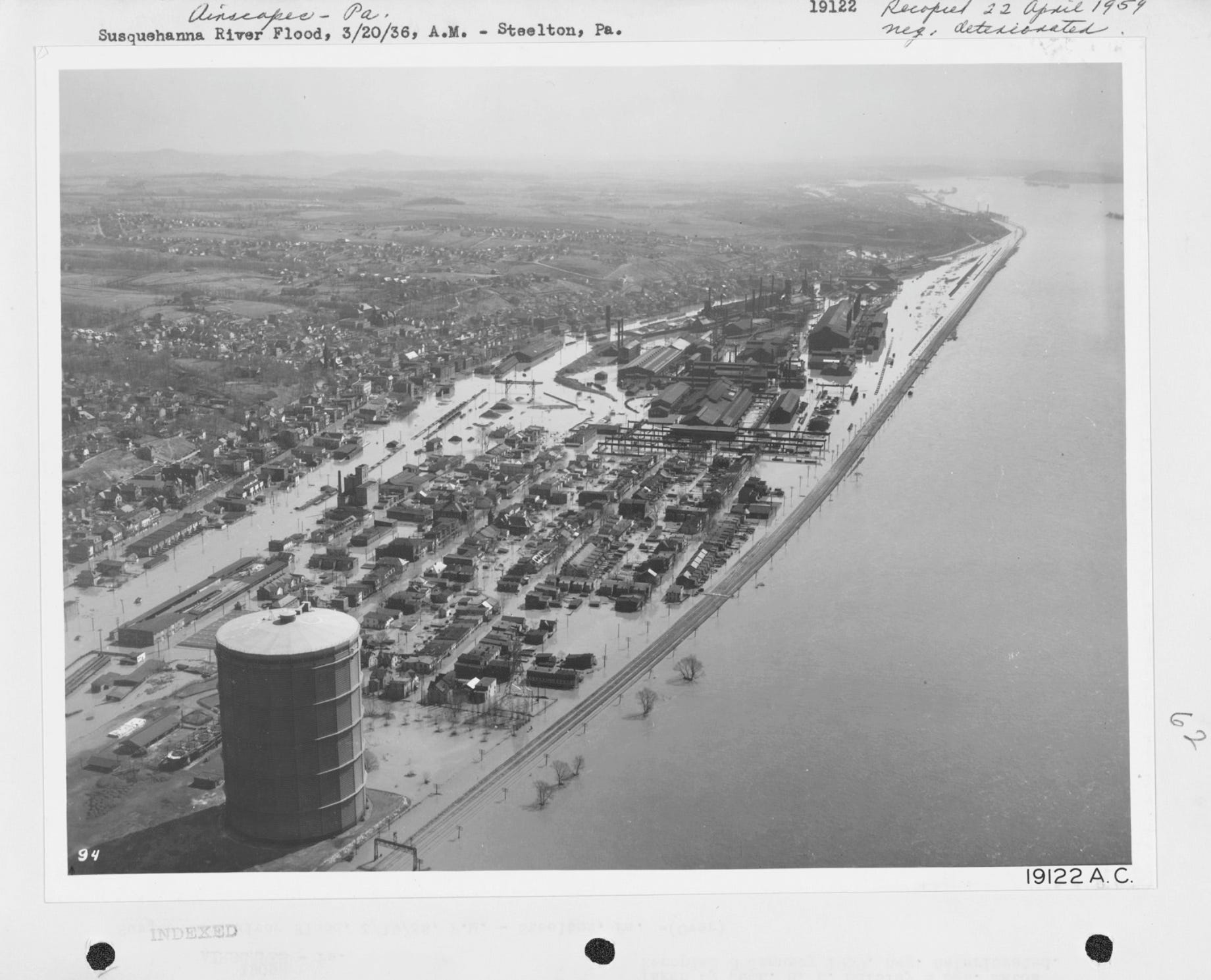
The town that would be Steelton rose in the 1870s after the PRC and its partners chose a bend in the Susquehanna River a few miles south of Harrisburg as the 97-acre site for a steel mill. What was once farmland and riverbank almost immediately became an industrial settlement, initially named Baldwin after the founder of a steam locomotive company, but by 1880, it was re-founded under a more literal name.
In those early years, Steelton resembled the caricature of the company town as a pure “exploitationville.” Immigrants arrived from Europe and elsewhere, and black workers journeyed from the South during the Great Migration. They rented beds in company row homes and worked alternating shifts in a system of industrial hot-racking. “You’d get out of bed, tap the next guy on the shoulder, and go to work,” said Sean Pisle, a fourth-generation mill worker who also serves as vice president of the local union (United Steelworkers Local 1688). It was brutal work, and there’s a reminder of just how deadly it was in the basement of the steelworkers’ union. There hangs a memorial listing the names of all the workers who died on the job since 1912. A vast majority of the couple hundred names on the list were killed in work accidents in the first half of the 20th century, before the unions and OSHA.
In 1917, Pennsylvania Steel Company sold the Steelton facility to Bethlehem Steel, the company that provided the skeleton of America’s skyline over the next several decades. Its steel framed the Empire State Building, Rockefeller Center, Madison Square Garden, the Waldorf Astoria, and Chicago’s Merchandise Mart, and carried traffic across the George Washington and Verrazzano–Narrows bridges, and the Peace Bridge to Canada. The company’s success, paired with the rise of organized labor, meant that by the World War II era, Steelton’s relationship with its steel mill had evolved into something more durable and reciprocal than before. It did not simply extract labor and discard it. At its peak, the mill employed more than 9,000 people in a town of about 13,000 and anchored a stable civic ecosystem of schools, churches, grocery stores, parks, and public programs. Pisle described the city then as “middle blue-collar. Nobody got rich, but you survived.” In the 1950s, ’60s, and ’70s, he said, young men had three options: school, the draft, or “down the hill to the mill.”
But as the twentieth century dragged along, that choice increasingly seemed like a raw deal. Steelton was both a beneficiary and captive of the old economic system, thriving only so long as the expansion of track—and the flow of capital behind it—continued.
The Long Decline
The rail-and-steel economic system held together longer in Steelton than its critics expected. For much of the twentieth century, steel and rail continued to reinforce one another, even as technologies changed and corporations consolidated. Over the decades, the Steelton mill produced nearly every component needed to build and maintain a railroad. “You could get all your railroad products here in Steelton,” Union president LaRue Hess told me. Rail was the flagship product, but far from the only one. The plant made bridge components, rebar, pipe, forgings, and specialty alloys. Parts of the Golden Gate Bridge were fabricated there, as was rebar inside the concrete containment structures at Three Mile Island. The mill rolled submarine drive shafts for the Navy and heavy-equipment components for companies like John Deere and Caterpillar.
The financial fracture came slowly and then all at once. Beginning in the postwar decades and accelerating after the 1960s, the ground beneath the steel-rail loop began to shift. By the mid-twentieth century, heavily regulated railroads were suffering chronic financial losses as competition from highways and trucking eroded their traditional base, culminating in the massive Penn Central bankruptcy in 1970 that helped lead to government-led restructuring. Containerization and the rise of intermodal shipping did increase overall rail traffic, but it was a different kind of traffic: standardized containers moving imported goods over long distances, not the dense, steel-intensive industrial freight that had once bound railroads to domestic manufacturing. The 1980 Staggers Rail Act deregulated the industry, unleashing a wave of consolidation and efficiency-driven management strategies that made railroads profitable and Wall Street-friendly, but not in a way that restored the old industrial ecosystem. As global supply chains expanded, steel was no longer treated as a strategic national product but as a fungible commodity, increasingly sourced from abroad. Railroads responded by merging into a handful of large carriers, cutting costs, running longer trains with fewer workers, and prioritizing precision logistics over tailored industrial service, which boosted margins even as it hollowed out their relationships with customers like steel mills. The result was not the decline of rail itself—intermodal traffic and profitability grew—but the unraveling of the old, self-reinforcing engine of growth.
Like countless other manufacturing communities in America, Steelton experienced this shift not as a single catastrophic moment but as extended and painful attrition. Ownership changed hands repeatedly. After Bethlehem Steel collapsed in 2001, the mill passed through a succession of owners: International Steel Group, Mittal, ArcelorMittal—before landing with Cleveland-Cliffs. Each transition brought with it a sense of uncertainty: equipment aged, and processes that relied on manpower rather than automation became more expensive. The Steelton mill had only 800 workers left by the beginning of the twenty-first century.
The mill survived by specializing. It could roll shapes others had to cast and handled small, high-value orders that required precision rather than volume. “There’s not a huge market for some of the stuff we made,” Pislo said, “but the people who need it don’t have another supplier.” But what it increasingly could not do was make rail in the lengths preferred by modern railroads. As rail companies standardized on quarter-mile sections to reduce joints and maintenance costs, Steelton remained limited to shorter segments—often eighty feet. “If another place can make 320-foot rail, and we can only make eighty-foot rail,” said Hess, “one of them’s got a lot more joints in it than the other—and they don’t want joints.”
What Steelton needed for the future was not a miracle, but capital. Engineers and union leaders had already mapped out the options. A partial modernization—workers jokingly call it a “restomod,” borrowing a gearhead term for a vintage car restored with modern parts—would have cost roughly $150 million. A fuller, from-scratch universal rail mill would run closer to $800 million. Either investment would have allowed Steelton to produce longer, cleaner, more efficient rail in a single linear process, eliminating the inefficiencies that had slowly priced it out of the market. For an industry that routinely spends billions on acquisitions and stock buybacks, these were not unimaginable sums.
