

The New Tribalism
If we are to have true reconciliation in America, it will not be done with escapist ideologies and token programs. It will be done with political commitment to building a majority movement for change.


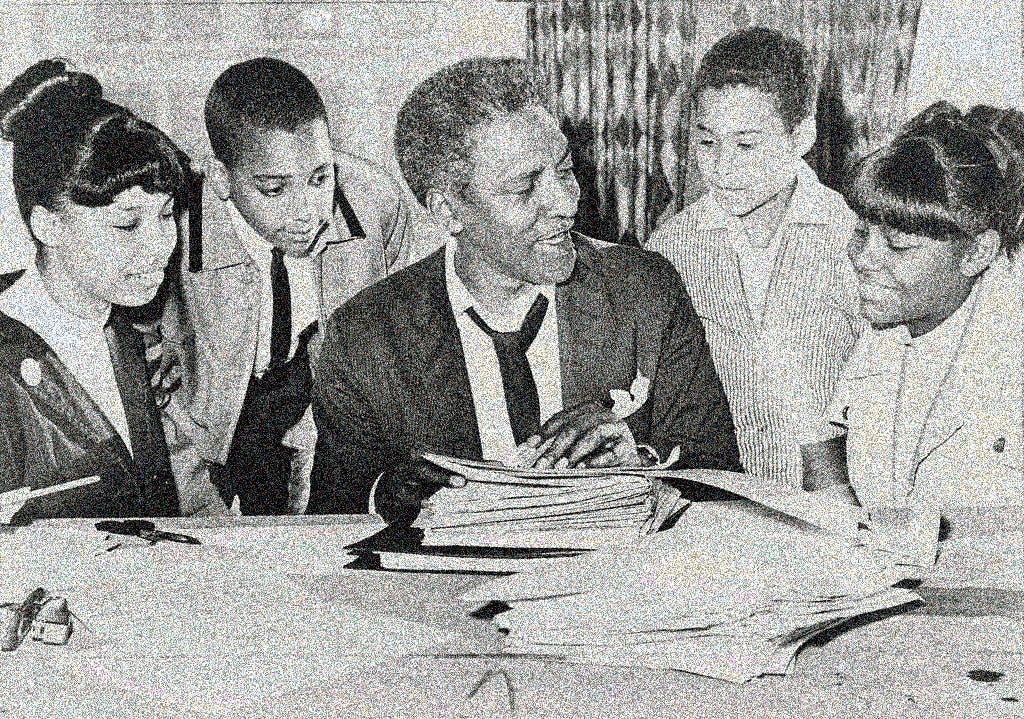
Bayard Rustin, lead organizer of the March on Washington for Jobs and Freedom and Executive Director of the A. Philip Randolph Institute, delivered the following speech at Clark College in January 1971. It didn’t make the cut for our new volume, Rustin’s Challenge, but it’s a great speech regardless. For more of Rustin’s writings and insights, pick up a copy of Rustin’s Challenge today.
The college educated are an elite amongst black people, and as an elite they must bear certain responsibilities that go along with their privileges. There is a tendency to want to escape these responsibilities, to retreat into various forms of alienation, and it is this tendency to withdraw from responsibility that we must oppose with the same firmness and idealism with which we have fought for racial justice.
The dominant philosophical notion amongst the elite today is what I call a new tribalism. This consists in turning in on yourself in an alienated form rather than trying to solve an objective problem. A problem which is “out there.” This tendency is world-wide. Thus, the French Canadians don’t want to be a part of Canada. They want to do their French thing, which is of course an impossibility. The Walloons in Belgium do not want to be a part of Belgium. They want to get over in a corner and do their thing. It was most interesting when I was last there. They’re talking about “Walloon food,” just as some of us talk about “soul food.” The Luos in Kenya don’t want to be a part of Kenya. They want to do their Luo thing. The Eritreans who joined into Ethiopia after the war don’t want to be a part of Ethiopia. Anybody who wants to discuss black unity had better face the fact that there are sixteen African countries in which there is nothing but division, fighting going on. And the one between the Eritreans and the Ethiopians is one such conflict.
In other words, the feeling that “I want out” is part of a world-wide trend. Now this trend always proceeds from the same psychological syndrome. It proceeds from the syndrome of hope followed by disappointment followed by turning away from the reality into one’s own bosom.
Alienation and withdrawal always proceed from hope, though this may seem surprising. No desire for social change is possible except where there is hope. But the fruit of hope unfulfilled is disappointment and internalization. Now that is why you have to be responsible, because it is the educated amongst blacks who have hope. There is very little hope in the slums. They cannot have hope because there is no way for them to leave.
But hope can also give rise to revolutionary feelings. Show me a black man who is in despair, who spends all his time talking about the blue-eyed white devil, and I will show you a man who will make absolutely no contribution, because he is in despair and change springs from hope.
Now I would like to show you how this works from our own black history. Hope, despair, internalization, black nationalism, and further despair. In World War I, there were 300,000 black American soldiers in France. “After the war is over,” they thought, “we’re going to come back home and we’ll have freedom.” Great hope! But what happened after the war was that they came back to find that they were being driven off the farms in the South. They were terrorized by the Palmer raids and lynched by mobs, and of course there was unemployment. So their hope turned to despair. And because of their despair, they turned their minds from reality. Thus, in the 1920s you got most black people thinking it was revolutionary to follow Marcus Garvey, who had no program whatsoever.
Marcus Garvey’s movement was essentially a movement for the economic uplift of relatively well-off West Indians. It provided absolutely nothing for the average black man. Yet many followed because they had lost hope in everything else.
You have the same thing happening today. When Dr. King spoke in Washington in 1963, everybody had great hope that the problems would soon be solved. And in fact, we got the ‘64 bill and the ‘65 bill. But what happened? Following Dr. King’s speech, unemployment amongst black people continued; the school system was worse than ever before; medical care got more expensive than ever for the great masses of blacks. So there was despair. And it is in this context of hope followed by despair, that you get a series of leaders who are essentially non-leaders. They shout slogans and before you know it they disappear, because the conditions today produce internalization. Despair leads to irresponsible leadership.
And so every year, with the help of the white press, you will get a new leader. This year it will be Stokley Carmichael, who has absolutely no program. Next year it will be Rap Brown, who has no program. The year after that Robert Williams will be flying back from China to start the revolution, but it will not come. The next year it will be Huey Newton, who comes out of jail to start the revolution which will never come. We will have one non-leader after another because they speak to the deep alienation and despair of the people.
Then you get the internalization on the part of many people like ourselves. Instead of seeing that the problem is economic, social and political, we turn in on ourselves out of despair. Instead of seeing that the problem is adequate medical care, we substitute how long we grow our hair, which will solve absolutely no problem whatever. Or we substitute talking about “soul food.” I was up at Yale University where the woman who teaches the soul course spent two hours teaching the youngsters there the proper way in which to cook pigs’ feet. If one thinks it is important whether we call ourselves black, Negro or an Afro-American, we are only ignoring history.
The founder of the first black newspaper in this country spent the whole first page of that newspaper describing why one should call oneself a “colored” American. Fifty years later, W.E.B. DuBois wrote a letter to a young girl who asked him what she should call herself. And he said, “Obviously, the logical thing is to say, Negro.” Malcolm X spent half of his adult political life telling people that they should call themselves Afro-Americans or black men. And that debate is not new. It goes on because black people have their backs against the wall economically. And it will disappear. (For example, the Garvey movement was destroyed not because Garvey stole money. Maybe he did, maybe he didn’t. Who cares? What destroyed it was that the CIO was formed and the trade union movement began to take black people into it by the millions. The minute black people had faith again in America and were no longer alienated, they forgot Garvey.)
Now this is important, because if we’re going to understand this syndrome we must understand what is false and what is not false. I maintain that the so-called alienation of black and white is unreal. Alienation of male and female is a false statement of the proposition. Alienation between young and old is a false statement of the proposition. For example, I maintain that there are greater differences between people under 30, than there are between people over 30 and people under 30. Illustration: George Wallace received his greatest support from people under 30. He got the lowest vote from those between 50 and 60….
The basic alienation in all societies is between poor people and affluent people. That’s where the problem is, and where it will always be. And it won’t be easy to solve. I’m sometimes astounded at how absolutely unmindful so-called radical black people are. Anytime the man comes to you with any proposition, you should never swallow it right off; you know, like decentralization of schools. When did the man ever come to me and offer me power? He wants to give me control over my ghetto. Watch him, he’s up to something.
Or when he comes to you, talking about black capitalism. Now my friends, if white capitalists, manipulating billions of dollars, permit white poverty to exist in Appalachia, how is this half dozen Negroes you got in Atlanta with their little banks and insurance companies, going to end black poverty in the United States? It’s impossible. When Mr. Brimmer tells them that these banks are charitable institutions which will have little or no effect upon the ghetto, they jump on him as if he’s said something naughty, when he’s merely told the truth.
To solve the problem of poverty requires not some small program or even a spiritual revolution, but a profound social revolution. Let me give you an illustration of what I mean because people can get all hung up on spiritual foolishness. Not that I don’t want spirit in it, but take Thomas Jefferson for an example. He wakes up one night and decides slavery is wrong. So he feels guilty. He writes a note saying on his death his slaves shall be free. Now he’s so relieved, he’s no longer the evil man that he once was.
The fact of the matter is, Thomas Jefferson did us a profound disservice, and found himself a cop-out. What he should have done was to have seen that the solution to social evils cannot be found in the soul, but in the Congress of the United States. He should have gone into the House of Representatives and into the Senate and started getting a bill passed to do away with slavery itself. That’s what he should have done, but he didn’t.
Now what is alienation? It is the feeling that my mind and my hands are cut off from the production of goods and services or from any meaningful social function. Here again, if you really want to find out where the real alienation is in America, it’s among the wealthy middle class. They are the ones who say America stinks; that you can’t bring progress into the United States; that everything is wrong; that we’re leaning toward fascism—that old foolishness. That’s what they say. And so they give money to radical blacks to carry on their revolution for them by proxy. Of course, blacks are not going to do that. Not because they are unmindful or ungrateful, but because it cannot be done that way and they know it.
We have to understand three basic dynamisms: (1) black rage; (2) white fear; and (3) affluent guilt.
Now I don’t have to talk about black rage, you know about that. What you do not know about is white fear. Whites are going to be fearful in this society, and the talk about racism is not going to have a single thing to do with it.
White fear means whites are fearful of black people, but not in the terms of the Kerner Commission report. When the man writes up a report and says he’s a racist, be careful. Don’t do what he wants you to do, which is to get the biggest kick on earth out of the fact that the government reports said all whites are racists. So what? The question is what you do about it. If you’re not going to send them all to a psychiatrist, why make a psychological analysis of it? If, however, the man had said the problem is jobs, free medical care, full employment, free education, it would be different. But he didn’t say those things, which are precisely the problem, because he’d have to pay something for solving it. As long as he calls himself a racist, he can divert our attention from any solution to the problem.
I’ll bet you there is not a class on this campus that hasn’t discussed racism. Our fixation on racism, as important as the problem is, has obscured the effects of the technological revolution upon blacks. This is never discussed. It has obscured the tax policy of the United States, which is brutalizing blacks. This is also not discussed because we get such a kick out of calling people racists. It obscures the effect of the policy of the government in regard to land costs. It obscures what is happening to blacks being driven off farms because you can’t say they’re being driven off farms today merely because of racism. More basic factors are at work. Therefore, our fixation on racism harms us because it obscures many of the major problems we face.
At root the problem is not really racial. If I took every black in Chicago, in Detroit, in Philadelphia, in Washington and in Atlanta between the ages of 18 and 25 and turned them white tomorrow, they still will not get jobs. The problem is that Mr. Nixon has decided that unemployment is the answer to inflation. So he has created unemployment. And this produces racial division because whites are fearful that we will get their homes, and we are enraged because we do not have homes. What I am suggesting here is that alienation and divisiveness will not be overcome because we like one another. True reconciliation proceeds from effective economic and social programs.
Let me give you another illustration from American history. The Abolitionists had a spiritual mission cut off from any economic and social program. They said, “We are against slavery. We want the slaves freed.” They helped in this, but when the slaves were freed and said, “We want 40 acres and a mule,” the Abolitionists had gone home. The Abolitionists never created any social and economic program to back up real freedom for black people. What I am saying again here is that we may be able to get out of the problems we are in if we avoid certain traps.
If we are to have true reconciliation in America, if we are to overcome our alienation from one another, it will require a total commitment to solving the underlying problems of the society. This will not be done with words alone. It will not be done with escapist ideologies and token programs. It will be done with political commitment to building a majority movement for change, and with social commitment to using newly gained political power for the cause of social justice.
Bayard Rustin was lead organizer of the March on Washington for Jobs and Freedom and Executive Director of the A. Philip Randolph Institute.