

Men at Work
What’s wrong with more muscle-power jobs?


Below is columnist Dustin Guastella’s piece from our forthcoming (and final) print issue, “Trains,” which will be released this spring. You can also catch Dino discussing manufacturing, jobs, and populism on the most recent episode of Joshua Citarella’s excellent podcast Doomscroll.
Men today are earning less, learning less, and increasingly dropping out of the job market altogether. And to add insult to injury, this crisis has become cheap and reliable culture war fodder.
Among conservatives the obvious culprit for the backslide is feminism. The right-wing writer Helen Andrews recently claimed that women ruined the workplace by ushering in distinctly feminine ways of handling conflict, ultimately driving men down and out. On social media, “manosphere” influencers like Rollo Tomassi and Andrew Tate expound on the ways that working women have emasculated men and robbed them of their roles as providers. And still other conservatives have seized on DEI initiatives as a source of male disadvantage, prompting Trump’s Equal Employment Opportunity Commission to announce that it would shift its focus to investigating cases of discrimination against white men. Meanwhile, on the other side of the aisle, liberal feminists blame “toxic masculinity” for men’s failing fortunes in life, love, and work. “It’s people who want to keep men trapped in the 1950s, adhering to rigid gender stereotypes that make them fundamentally unhappy,” argues a Guardian columnist.
Regardless of their political bent, these theories of the roots of the “male malaise” share two essential ingredients. First, they are largely limited to men in professional fields. For instance, while aggressive diversity initiatives are a common feature of the white-collar workplace, they are not nearly as prevalent on the blue-collar jobsite. Second, they all primarily turn on cultural lines. That is, they assume that cultural values and social attitudes are the main drivers of the troubles men are having.
But the problem facing men today is much larger than the cultural maladies identified by the literati, left and right. In part, the problem is the literati. Or at least an economy that privileges them.
The truth is that not all men are falling behind. In our K-shaped economy, highly-credentialed men are still doing exceptionally well. College-educated workers, male or female, not only wildly out-earn those without a degree, but also see this wage premium double over their lifetimes, rising much faster than lifetime wage growth for routine and manual workers. Relatedly, the labor force participation rate for prime-aged men without any college education is nearly 30 points lower than it was in the 1980s. The vast majority of victims of the male malaise, then, are those on the low end of the totem pole. And we don’t need any theory that correlates female diligence with male idleness to explain this. Nor should we look for blame among the myriad other cultural culprits. Rather, the straightforward cause of so much male joblessness and hopelessness is the disappearance of muscle-power jobs.
Work Without Muscle
In 1987, in what was probably his last public address, Bayard Rustin warned of the coming collapse of the blue-collar labor market. He noted that past waves of immigrants had arrived in the United States with “nothing to work with except sheer muscle power” and had managed to achieve economic security precisely because there was an abundance of manual work to be had. Yet, he continued, as the result of ongoing technological shifts in production and distribution, American workers might never again “use muscle power as an upward mobility.” Those who had nothing but brawn to sell, and, in particular, black workers—who were disproportionately employed in said jobs—would be left behind.
This, of course, had nothing to do with some shift in attitudes or cultural values: “Ship owners did not get in a corner and say we hate blacks and therefore we’re going to create a technological proposition which will wipe blacks off the waterfront,” Rustin pointed out. “They simply said technologically it’s cheaper and better to ship goods in containers. And at that point blacks are off the waterfront, with nowhere to go because they were there with their muscle power.” Left unsaid was that almost all of those workers were also men.
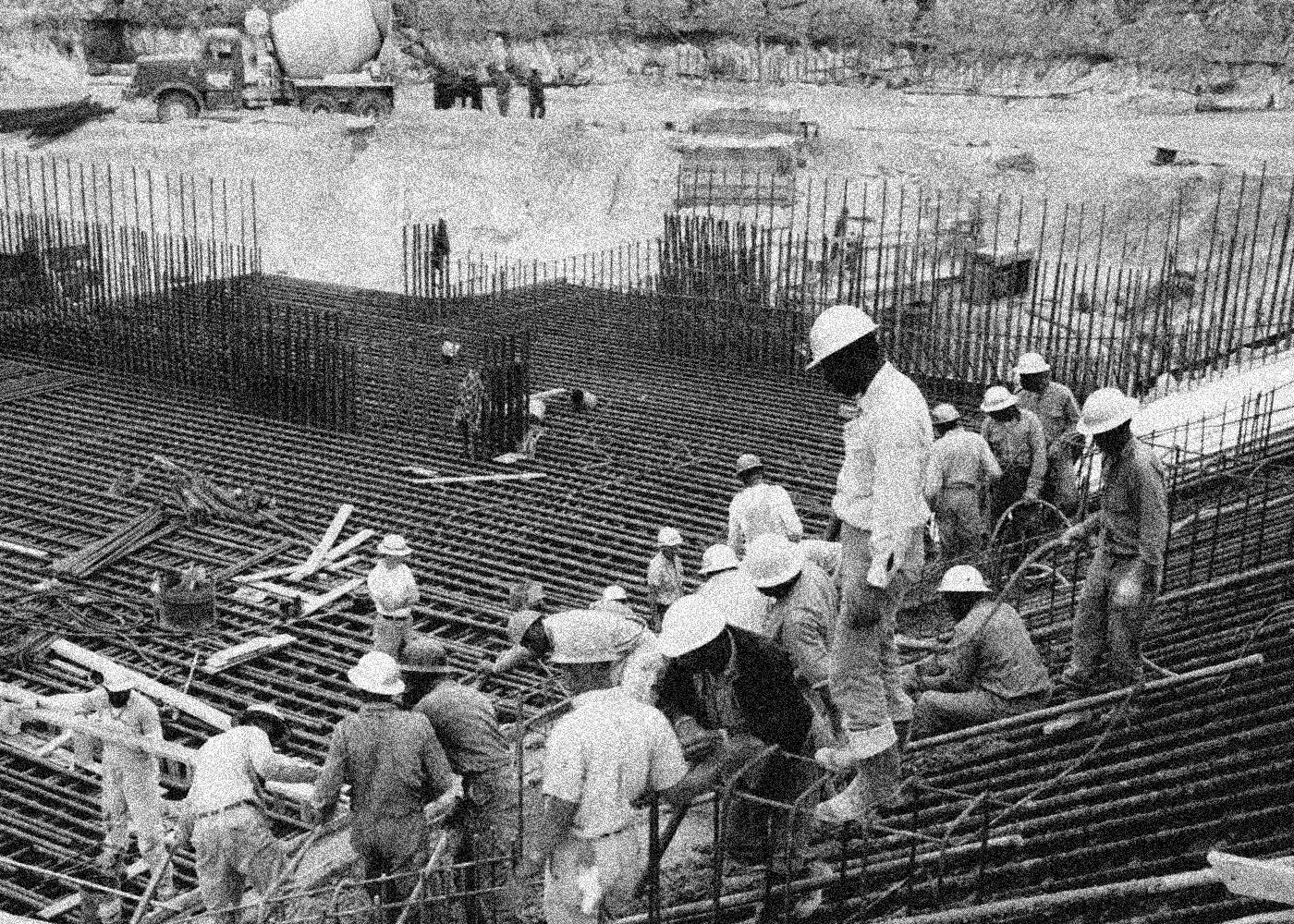
Sure enough, since Rustin’s prediction, blue-collar work has steadily vanished. This disappearing act has been driven largely by the collapse of manufacturing, which made up nearly a third of all employment in the late 1970s, but today makes up less than one tenth of all employment. Other blue-collar sectors have shrunk as well: Jobs in rail have imploded from around a half-million employees in the 1980s to just 150,000 people today, even despite yearly increases in tonnage. Jobs in logging, mining, oil and gas extraction have contracted with absolute decreases in the tens of thousands year-over-year since the 1980s (save for the brief fracking boomlet of the mid-2000s). Jobs in construction don’t follow the same secular decline, but suffered a catastrophic collapse after the 2008 housing crisis and took more than a decade to rebound to their pre-crisis levels. (Today, thanks to President Trump’s policies, construction work is again contracting, while wages and standards deteriorate.) Warehousing and transportation remains one of the last great strongholds of manual labor jobs, but thanks to recent breakthroughs in robotics and automation, the giant new plants that dot the outer rings of cities are hiring only a fraction of the workforce that warehouses half their size once did.
None of this was an accident. Policymakers have, for the last forty odd years, declined to combat this precipitous fall and instead encouraged the growth of the “knowledge economy.” Larry Summers, one of President Clinton’s chief economic advisors, summed up the strategy as one that encouraged more people to go to college, got the government out of the way of private investment, and increased the “openness” of global markets through huge free trade agreements. Admiring his work, he bragged: “NAFTA didn’t cost the United States a penny.” Except, of course, what it costs in terms of jobs and lost wages.
The transition to an “eds, meds, and beds” economy has been advantageous for the college-educated, but it’s been disastrous for those without college degrees, and in particular for men. Consider, real wage earnings for college-educated men have grown around 20 percent since the 1980s. For college-educated women over 35 percent. Non-college educated women, meanwhile, have posted anemic wage growth: around 1 percent over the same period. But non-college educated men? They’ve seen their earning power crumble, their wages having decreased by 10 to 15 percent. Here is the real cause of so much male malaise. As millions of men were left stranded in low-wage service jobs, in dead-end former industrial towns, journalist Hanna Rosin, author of The End of Men (2012) had noted that younger men especially were becoming “unmoored, and closer than at any other time in history to being obsolete.”
Unfortunately, few on the Left heeded Rustin’s warnings in the 70s and 80s, and today progressives remain remarkably complacent about the consequences of the New Economy. Too many look at the contemporary economic trajectory as natural and, therefore, unchangeable—and at a time when our rapidly decaying infrastructure and the industrial demands of a massive energy transition are crying out for muscle power. They insist that economic development requires going through historical stages whereby workers shift first from agricultural work, then upward into industrial work, and finally upward again into services. Any negative effects of these transitions are simply the price to pay for progress.
But why isn’t it seen as a problem—an emergency really—that good-paying muscle-power jobs are fewer than in the past? Isn’t there anything we can do to ensure that those who have nothing but sweat to sell can get a decent price?
When questions like these are raised, some progressives transform, as if by magic, into the stodgiest conservatives. Utopians who have imaginations wild enough to dream about a world without police, prisons, gender, and borders will insist that it’s impossible to bring a single factory back, or build a new bridge, and that the working class (working-class men, especially) should simply seek work elsewhere. University of Chicago historian Gabriel Winant, for instance, penned a New York Times op-ed complaining of the utter futility of trying to reshore industrial jobs, even as he conceded that the disappearance of these jobs had “left behind populations that were poorer, sicker and older.”
To rephrase Federic Jameson’s infamous quote, for some socialists, it seems easier to imagine the end of capitalism than it is to imagine the building of a new auto plant.
