

Make America Again
A populist case for American pride and patriotism


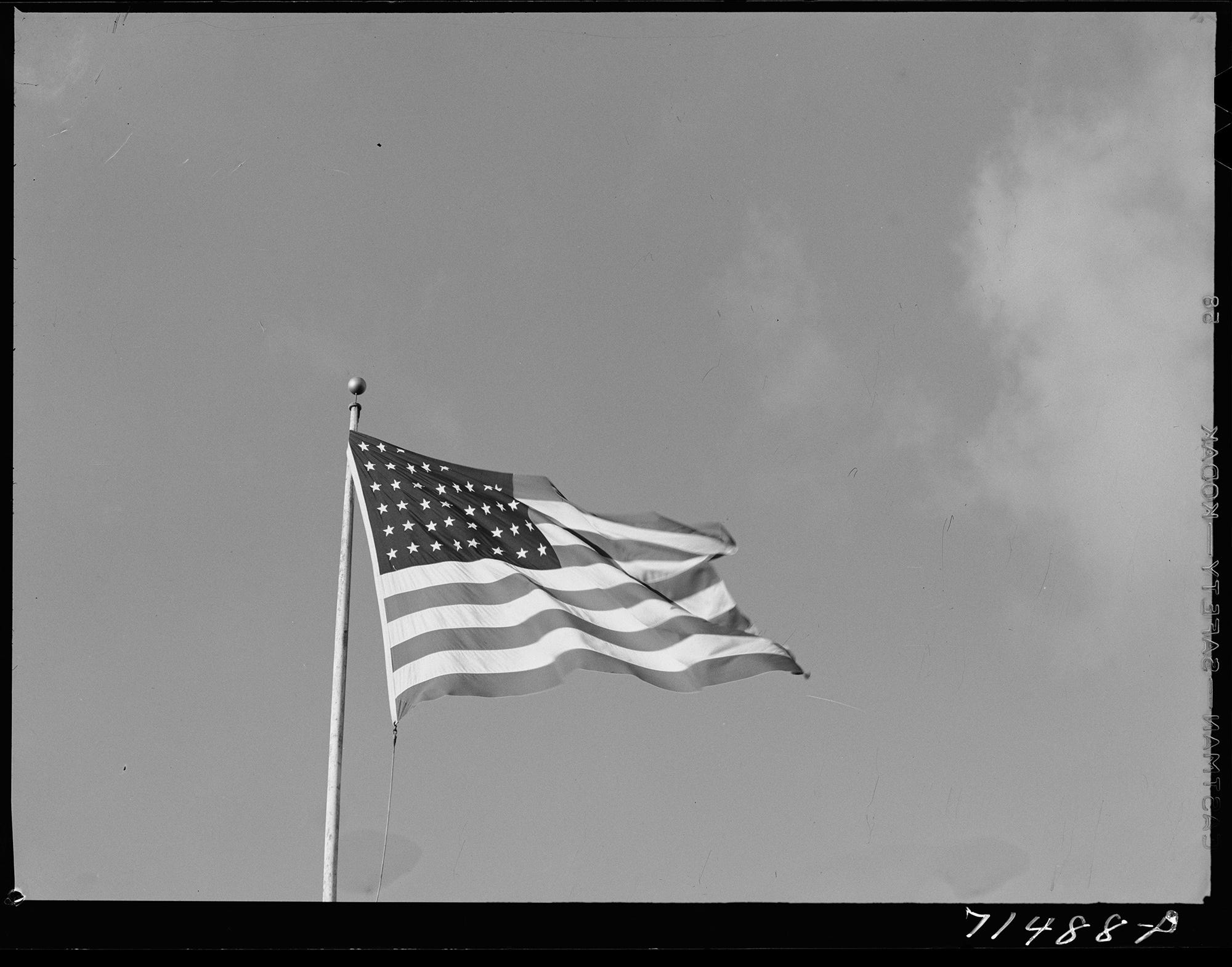
Out of the rack and ruin of our gangster death,
The rape and rot of graft, and stealth, and lies,
We, the people, must redeem
The land, the mines, the plants, the rivers.
The mountains and the endless plain—
All, all the stretch of these great green states—
And make America again!— Langston Hughes
Americans have been giddy watching World Cup tourists marvel at American patriotism. On social media, foreign nationals have gone viral for expressing their admiration, and maybe even envy, at American culture and the unabashed national pride on display in gigantic flags in Walmart, ubiquitous star-spangled bunting, and red, white, and blue flyovers.
The trouble is, it’s all a little fraudulent. One America-admirer, a Swedish woman named Elsa Thora, briefly became an internet sensation for her enthusiastic appreciation for ranch dressing and down-home American patriotism. It was later revealed that Elsa was self-marketing for her OnlyFans account and pimping a Curacao-based online casino that only accepts cryptocurrency. But this is oddly fitting, because the patriotism she supposedly admires is, in many ways, also a false front.
A 2023 survey from the Wall Street Journal found that only 38% of Americans viewed patriotism as very important, down from 70% in the late 1990s. A Gallup poll from this year noted a double-digit drop in the rate of people who claim to be “extremely” or “very” proud to be American. No doubt the slump in national pride reflects our general social and economic malaise, where achieving the American dream only gets more difficult by the year. Progressives, unsurprisingly, are feeling especially pessimistic: while 92% of Republicans surveyed proclaimed their American pride, only 36% of Democratic voters said the same.
You may agree that there is little to be proud of right now, given the country’s senseless war against Iran, oligarchy at home, and a widespread sense of social unraveling, to name just a few of our current problems. But the distinct lack of progressive patriotism is a problem, because an expression of belief in, and love for, the American project remains essential to winning the political loyalty of the majority of Americans. Even in moments where people feel a bit of flag fatigue, they won’t flock to those who have no love for their country. As Michael Harrington once argued, “If the Left wants to change this country because it hates it, then the people will never listen to the Left and the people will be right.”
The progressive distaste for patriotism wasn’t always a given. In fact, patriotic fervor was once principally associated with root-and-branch reform. So identified with rebels and rabble-rousers was patriotism that in 1773, Samuel Johnson amended his dictionary definition to note that the word “is sometimes used for a factious disturber of the government.” True to form, American revolutionaries of 1776 proudly called themselves “Patriots” against King George’s “Loyalist” sympathizers. Patriotism even came to define what it meant to be “Left.” During their own revolution, opponents of the French monarchy—organizing themselves in les sociétés patriotiques—famously sat on the left-hand side of the National Assembly, inaugurating our tradition of referring to progressive factions as ‘the Left.’ During World War II, resistance fighters battling fascism in Europe had no trouble declaring themselves patriots and draping their squadrons in republican colors. The Nazis, by contrast, shunned the very notion: “I was a nationalist,” said Adolf Hitler, “but I was not a patriot.” Where patriotism appeals to love of one’s homeland, its culture, and the people who live there, nationalism instead appeals to tribal, ethno-mythological and racial bonds. To that point, Hitler, an Austrian, was willing and eager to destroy his own patria for Aryan glory.
In the United States, patriotism was a thoroughly bipartisan value following the war. FDR’s Four Freedoms were most famously depicted by Norman Rockwell, the premier painter of Americana, and yet another Norman—Norman Thomas, who ran for president six times as the Socialist Party of America’s candidate—frequently characterized his socialist appeals as the “truest form of patriotism.”
But then came Bull Connor’s dogs, the Vietnam War and Watergate. During the tumultuous 1960s, the New Left burned draft cards and some students stomped on the flag. Around the world anti-colonial movements made domestic progressives feel embarrassed or ashamed of their country, which suddenly appeared to represent less-than-noble ideals. Meanwhile, increasingly visible political corruption at home made promises of fairness and democracy ring hollow. In the wake of such upheavals, the Democrats, the catchall party of progressives, became more closely associated with national pessimism than pride.
As a consequence, today patriotism is firmly the province of conservatives. This is an unfortunate and dangerous development because once patriotism is owned by one faction or party it degrades into the grotesque. It becomes chauvinist nationalism. Instead expressing love of country, of plebeian culture, and of citizen compatriots, the nationalist looks for enemies within.
Acknowledging the dangers of ceding patriotism to the Right, left-leaning political commentators will periodically implore their comrades to again wrap themselves in the flag; to recover slogans dripping with stars and stripes; to not be so embarrassed of the country they claim they want to lead. Maybe because 2026 is a year of national spectacles—the Winter Olympics, the World Cup, and now the Semiquincentennial—such exhortations have reappeared lately. In an Atlantic article titled “The Left Needs to Rediscover Its Patriotism,” Michael Kazin made the case for appealing to the best of the American tradition in its most progressive forms. At The New Yorker, Arthur Krystal encouraged national pride built on the notion that the founders wrote in a failsafe injunction for citizens to make “a more perfect union.” The massive No Kings rallies earlier this year had no shortage of American flags, nor of left-leaning commentators celebrating that very fact.
Yet, as much as I agree with these sentiments, and as much as I wish for a more patriotic populism, rebuilding the patriotism of the Left can’t be done simply through rhetorical appeals or symbolic reclamation. Patriotism cannot be willed into being when the present social and economic conditions militate against fostering a deep love of country.
The dearth of patriotism on the political left today isn’t only the product of the received anti-colonial wisdom and cynical slogans of ‘60s radicals. The deeper problem is rather the underlying political-economic transformation that altered the social makeup of the Left and the foundations of progressive ideology; a transformation that drove educated progressives away from the flag and, in equal measure, from the working class of the “left behind” regions. Such progressives, incredibly, now even shy away from the very mention of America. As Kazin has recounted: “In 1998, the president of the American Studies Association rejected the very name of the organization she headed. Dismissing the ‘notion of a bounded national territory and a concomitant national identity,’ Janice Radway wondered whether it made sense to ‘perpetuate a specifically ‘American’ studies’ at all.”
That critique of “bounded national territory” expresses more than a passing post-colonial academic fad. It reflects the basic economic philosophy of the decade. With the fall of the Soviet Union, governments across the globe commenced a mad dash to tear down walls and usher in a new and ever more global economy. The de-nationalization of national economies, driven by high-finance, free trade, and digital communications, helped degrade the social basis for patriotism by recasting progress as a process of reaching greater heights of globalization. Center-left parties on either side of the Atlantic, beginning with Bill Clinton and continuing apace through Barack Obama in the US, embraced this global turn, aggressively courting highly-educated and high-salaried “knowledge economy” professionals to their political tent.
Today, in a stark reversal of the political battle lines of the twentieth century, the Democratic Party now controls two-thirds of all top-income districts. These elite liberals, roughly the top 20% of the income ladder, own the vast majority of the nation’s wealth and account for nearly 60% of all consumption. While they do many things for work, they are loosely connected by a Brahmin, cosmopolitan outlook. They are global citizens, or, more accurately, world consumers. As Philip Cunliffe argued in his 2025 book The National Interest, these well-to-do liberals who once clung “tightly to chauvinistic visions of nationhood” have since “renounced the nationalism while keeping the chauvinism.” These are the types who pretend to be Canadian when on international vacations, and who fret aloud, without a hint of self-awareness, about how embarrassing American popular culture is. (It’s embarrassing, of course, to an audience of other cosmopolitan elites, not to those “flyover” Americans whose approval they have no interest in winning.)
And what of the working class? The race to globalize succeeded in aggressively disorganizing union movements all over the world. Working-class associational life was dissolved through the solvent of free-market fundamentalism. And as civic institutions ceased to play a meaningful role in social, political, and economic life, the efficacy of, and popular faith in, domestic democracy eroded. Meanwhile, free trade-induced deindustrialization generated new class frictions, which, as the German political sociologist Wolfgang Streeck argues:
…can be understood as a result of divergent interests vis-à-vis globalisation: a definition of the new middle class as a group who are believed to, or actually do, profit from globalisation, who have an interest in open international markets for their human capital, and who do not want to be held responsible for satisfying the parochial demands of the losers of globalisation for material or cultural compensation.
It’s this essentially globalist view that smothers rhetorical appeals to patriotism from the Left. Take the attitude of Jerusalem Demsas, publisher of the leading liberal outlet The Argument. Demsas, frustrated with Trump’s tariff regime, complained recently of how “insane” it was that she couldn’t just buy a cheap Chinese electric vehicle. From her vantage point, Chinese vehicle tariffs (imposed by both President Trump and President Biden) are no less than an economic crime against consumers concerned about climate change. No thought is given, however, to what might happen to American autoworkers if ultra-cheap EVs flooded the domestic market. Nor does Demsas consider it a priority that Americans ought to build those EVs right here. And she is hardly alone—virtually any discussion of attempts to reindustrialize our national economy is met with mockery by the liberal press. Even if these liberals were to cover their appeals in Fourth-of-July fireworks, their economic commitments demonstrate a profound ambivalence toward American industry, American workers, and American ingenuity. For them the goal of domestic policy is not to steer America to make again, but instead to fling the doors open to global commerce in order to allow the cosmopolitan consumer class to take what they can from the world market, American jobs be damned.
Even some left-wing populists who wish to rescue patriotic appeals have often failed to reckon with the depth of the thoroughly globalized outlook of the Left. In France, the left populist leader Jean Luc-Melenchon, for instance, has encouraged citizens to reframe patriotism, arguing, “Being French does not mean belonging to a particular religion or having a given skin color, cooking certain dishes, or loving specific works. To be French in the Republic is to subscribe to the program ‘liberté, égalité, fraternité’ and respect the law.”
But believing in some set of Républicain political ideals doesn’t make one French anymore than believing in First Amendment Rights makes one American. While these lofty political values are certainly something the French (and we Americans) ought to be proud of, so too are baguettes and Bresson. In 1831 Alexis de Tocqueville complained of Americans’ “irritable patriotism,” which he described as a defensive posture devoid of any apparent affection for the United States; he attributed this to the still-young country’s lack of local customs, traditions, or even a culinary culture. A patriotism of reason alone is thin gruel. It took centuries for America to develop its distinctive culture, and the truth is that it’s the love of that culture that animates patriotic passion—when you’re abroad you don’t get homesick for the Constitution as much as for barbecue (and American tobacco).
That’s why it was depressing to learn that Melenchon’s party, La France Insoumise (LFI), has reportedly been incensed by the wildly successful “patriotic banquets” staged across the country. For a small fee, attendees of these banquets join hundreds of others to eat traditional French local fare, while singing folk songs and downing red wine. Critics of these gatherings have pointed out that the events are sponsored, in part, by deep-pocketed conservative activists. But the resentment seems to run deeper: if their primary concern was unsavory political ties, why couldn’t the LFI just host patriotic banquets of their own? I worry that it’s because the display of any kind of national pride is considered too much an embarrassment to the thoroughly globalized Left.
To be sure, the plastic patriotism of the Right is cynical. Worse, it’s funded by the very billionaire globalists that right-wing populists purport to oppose. While their broadsides against mass migration and globalism have helped drive hard-right parties to power all over the world, these pseudo-patriots have no vision for restoring popular sovereignty. Today’s nationalists might be happy to crack down on immigrants, but, at the same time, they have gleefully endorsed the global pillaging of national economies by the financial and tech oligarchy.
Consider tech titan Peter Thiel, who plowed some $10 million dollars into JD Vance’s 2022 Senate campaign. That investment turned out exceptionally lucrative for Thiel, with Vance becoming Vice President and Thiel’s company Palantir securing some $687 million in government contracts in 2026 alone. Still, despite how very good America has been to him—including subsidizing his largesse through taxpayer funding—the German-born, South African-raised, Stanford-educated libertarian has recently purchased a house in Buenos Aires in order to evade any tax liabilities stateside. Whither patriotism?
If the global consumer class is ambivalent toward the flag of their own country, the global ownership class loves all national flags, in exact inverse proportion to their tax rate. And so, each in their own ways, the educated elite and the global superrich conspire to make a mockery of patriotism. The result is a generalized cynicism. The rich really are in charge and willing to impoverish the domestic population just as they send their money on vacation to Caribbean tax-havens, and fortify themselves in faraway lands. No, neither the chauvinism of the hard Right nor the superficial idealism of the Left will birth a new future for genuine patriotism.
It won’t be enough to declare oneself an adherent of American ideals, and wrap oneself in the flag when giving a stump speech. To restore patriotism we need to build social, industrial, and cultural achievements worthy of national pride. And in order to do that we need political appeals that aim to renationalize our economy out of an expression of genuine affection for America and its people.
Just as globalism has sapped national sovereignty, any genuine patriotism must start from the premise that the nation-state isn’t just some unfortunate waystation on the road toward some future borderless utopia, nor is it merely a convenient place for a corporate tax identification number. Instead, the nation is the one and only home of democracy. This is one reason why the dominated classes all over the world express both a heightened sense of national pride, and a sense of palpable rage at the usurpation of popular sovereignty. The patriotism of the working class, so often derided by cultural snobs, is not an expression of backward superstition, but a recognition that the nation-state remains the only major site where plebeian control still, potentially, exists. As such, our commitment to patriotism ought to be more than idealistic or rhetorical but instead rooted in our distinct interests as citizens and a demand to restore national sovereignty over the market-rule dictated by the global financial and technological oligarchy.
The politics of populism must be a politics of place and a divestment from globalism must imply a concomitant investment in America. This country is beautiful and we’re blessed with all that is needed for a broadly shared prosperity. Yet, thanks to the pilfering of our rapacious ruling class, our built environment is crumbling, our industry flagging, and our social world is frayed. American-made products are an endangered species. Thanks to automation and offshoring, American workers have been robbed of the skills and wages needed to build personal esteem. Restoring pride, then, will mean literally retooling the American economy to accommodate American workers. While patriotism will not be constructed by symbolic acts, it can be physically rebuilt. Our pride ought to rise from a genuine appreciation, not only of abstract ideals, but of realized national achievements—of excellent infrastructure, exceptional schools, robust industry, safe affordable neighborhoods, beautiful parks and public places, and a skilled and confident domestic workforce.
To do any of this we need to domesticate—in both senses of the word—the global superrich by denying them subsidies, incentives and lucrative public contracts until they are prepared to declare their citizenship and pay their taxes. This, too, is patriotism, for it’s in no nation’s interest for the world to remain a borderless playground for the elite. We ought to adopt new Made-in America industrial policies, and complimentary trade agreements; we ought to impose new capital controls, and levy new taxes on the oligarchs. We’ll need new public factories, and to nationalize, or renationalize, firms in the national interest. Why shouldn’t America be able to build affordable electric vehicles at scale? While we’re at it, why not electrify the entire school bus, mail truck, and police cruiser fleets? And since all of this will require a new and improved electrical grid, why not invest in that as well?
No patriotism of the Left, however, will succeed if it fails to celebrate American culture and custom. A cornerstone of the New Deal was the government’s extraordinary investment in preserving and patronizing local culture and folk art. This was not by accident; reformers then understood that in order for popular economic sovereignty to be politically felt it also had to embrace and elevate the cultural achievements of the popular classes. A step down from the global stage should also allow us room to renew our seemingly exhausted cultural reservoirs. The reinvigoration of steel towns and fishing villages is no less a program of cultural conservation—a program devoted to the preservation of distinctly American ways of life—than of economic development. It is through this combination of political and programmatic patriotism that we can again renew our national pride. And here is populism’s great promise—not to belittle America for her faults, nor to mythologize her, but to have the vision and capacity to achieve what no meaningful political current has yet aimed to do: To make America, again.
Dustin "Dino" Guastella is Director of Operations for Teamsters Local 623 in Philadelphia and a Board Member of the Center for Working-Class Politics.
More and more people profess to hold post liberal politics of some kind….the claim is to recognise the limits of globalisation and its diminishing returns.
But, the litmus test remains the one set out in this piece.
Having pride in your country, does not require an abandonment of critical thinking - yet that thoughtful pride is often missing on our side.
Liking your fellow men and women, wanting to be in their company and seeing value in their culture and customs also appears a step too far for many liberals and avowed progressives.
As such, the need for working class communities to produce their own leaders, politicians, union stewards and representatives is essential. This must be the priority work for anyone invested in pro working class politics.
Also essential is the requirement to promote politics and ideas that brings the progressive middle class and working class people back together. To unwind decades of identity politics and to systematically replace them with ideas that emphasise shared interests and the common good.
There is a lot to do, and to think about, in the US, the UK and across much of Europe. Those who are ‘on our side’ but don’t actually like or are embarrassed by their own country are - I’m afraid to say- not going to assist or be useful in taking that work and thinking forward.
There is a grassroots community festival that I used to live near in NC that would constantly pump up Bluegrass artists and I always hated it. The sound of that music always sounded so cheesy and confederate to me, idealized hick hymns. Close friends of mine continue to position these genres as important and worthwhile, and it’s not until the last fee years I am having to admit that I was wrong for a very long time about it. I am learning more and more every day that there are positive forces at play in grassroots music culture to help the american south re-expeess and redefine it’s history and pride through art and music. The first time I saw a bald fat redneck wearing rainbow overalls I remembered how much cultural movement is happening behind the scenes. Good people are trying every day to coordinate their communities into living lives that both reflect their pride for their history but also love for their fellow man. I think centering recent conversations around basic definitions has benefited the left, most notably in its improving distinction in the public perception between leftistm and liberalism. I think the same effort needs to be expanded, in cases like this too. We seriously need to redefine and distinguish materials like Nationalism and Patriotism. This article is really inspiring and I think successful in that effort. This all reminds me too of some wisdom on
confidence. They say to have confidence, simply live a life that makes you proud of yourself. We all really want to be patriotic, but there is presently not much to be proud of. So why not take action we would be proud of?