


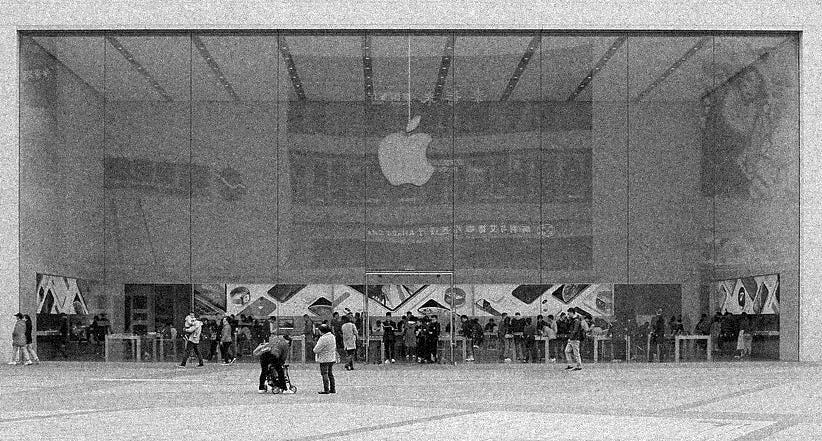
Review: Apple in China: The Capture of the World’s Greatest Company (2025) by Patrick McGee
China’s rise as the manufacturing center of the world has been nothing short of miraculous. Since the start of the reform period in 1978, China’s GDP per capita has grown nearly a hundred-fold. Hundreds of millions of people have been lifted out of poverty. With the famines of the Mao days long behind them, many Chinese now have middle-class living standards and reside in massive cities with top-notch infrastructure. More recently, China’s industrial policy initiative Made in China 2025 has made it the global leader in high-tech industries like solar panels, high-speed rail, and electric vehicles. While other East Asian states like South Korea and Taiwan have accomplished similar success, China is uniquely differentiated in the massive scale of its achievement. China is the development story of the last few decades and anyone who sees ending global poverty as a moral imperative must understand it.
While there are many reasons for China’s success, an essential ingredient has been foreign direct investment (FDI) from advanced countries. At the start of the reform era, Chinese officials set up “special economic zones” to bring in foreign investment and gradually introduce the country to global capitalism. To attract foreign investors, government officials offered tax incentives, regulatory exemptions, and new infrastructure. In exchange, foreign multinational corporations worked with local partners by entering joint ventures with Chinese companies. For a developing country without a strong industrial base or manufacturing experience, the technology and know-how brought by foreign multinational corporations is crucial for developing competitive industries. With foreign firms bringing in advanced production methods and training a labor force of tens of millions of Chinese workers, China eventually learned how to innovate on its own and grew to the high-tech industrial superpower that it is today.
Apple in China by Patrick McGee tells the story of perhaps the most important of these foreign investors, Apple Inc. Apple is one of the most valuable countries in the world today, with a market capitalization larger than France’s economy. While Apple is thought of as a quintessential American tech giant, the manufacture of their iconic phones and laptops are almost entirely dependent on one country: China. But despite China’s centrality to Apple’s manufacturing, the transition to China was gradual, unplanned, and far from inevitable.
