


In his 1980 Anti-Semitism and National Socialism: Notes on the German Reaction to “Holocaust,” Moishe Postone challenged the Left to think more clearly about the place of anti-Semitism in the mass psychology of Nazism. Postone saw his project as a political one: in his assessment, the Left of the late seventies and early eighties was failing to come to terms with the centrality of anti-Semitism to the Nazi project of an anti-capitalism of the Right. The Left, he cautioned, ought not think it has “the monopoly on anti-capitalism or, conversely, that all forms of anti-capitalism are, at least potentially, progressive.” In order to ground the left project in a commitment to dialectical materialism, Postone set out to show how anti-Semitism was at the heart of Nazi anti-capitalism.
In Postone’s reading of the Nazi imaginary, the Jew represented a concretization of the abstract elements of capitalism. Jews, with their supposed conspiratorial capacities to pull the strings of communists and economic liberals alike, were understood as personifications of the intangible, international domination of capital, and thus as the principal opposition to German autarky. Ridding the world of Jews was, for the Nazis, the heart of an anti-capitalist project that would open the door to ethnic German domination and expansion. Capitalism, in the Nazi reading, would be overcome by German autarky by advancing capitalism’s concrete elements (e.g., the ethnically German workers and the industrial products of the nation’s labor) while simultaneously ridding the world of the personifications of capitalism’s mode of abstracting labor into profit—world Jewry. For the Nazi, the Jew became a fetish, in the Marxist sense of the term—a concrete representation of the abstract elements of the contradictions in capitalism. The fantasied solution to suffering under capitalism was to eliminate that fetish.
Postone’s intent here was to warn the Left a) to look more closely at the great historical horror of the Holocaust and to understand anti-Semitism as the uncompromising motivation behind the Nazi project, and b) to maintain focus on the need for truly dialectical understandings of capitalism as opposed to a “foreshortened anti-capitalism that seeks to immediately negate the abstract and glorify the concrete.” This habit of mind that privileges the concrete over the abstract, Postone believed, represented a dangerous trend in left politics but also in other areas of thought as well, including in psychological theories that might begin to privilege emotions (the concrete manifestations of mental life) over thought (an abstract feature of mental life).
Postone’s invitation to look more closely at Nazism was an important one, and his ideas about the place of the Jew in the psychic lives of the Nazi masses is compellingly argued. However, he seems to have followed his own cautionary advice only too well. While his depictions of the place of anti-Semetism within the Nazi worldview feels accurate, a number of things that Postone holds to be “concrete” truths about the Holocaust have been recently shown by historian Adam Tooze to reflect a kind of impressionistic and associational thinking that misreads important aspects of the Holocaust as an abstracted industrial process.
Tooze argues in his recent essay, “What fires burned at Auschwitz? On the place of the Holocaust in uneven and combined development,” that Postone and many of his contemporaries on the Left misrepresent the Holocaust as the pinnacle of technological advancement geared towards mass killing. The Holocaust was paired by left thinkers at the end of the twentieth century with Hiroshima as representing the absolute horror that can happen when technological innovation and resources are geared towards killing. Postone claimed that Auschwitz, as a synecdoche for the Holocaust as a whole, was a “factory to destroy value, that is for the destruction of the personification of the abstract,” and that—according to these writers—the centrality of anti-Semitism to Nazi ideology could only be understood in light of the fact that “in the last years of the war when the German Armies were being rolled over by the Red Army, a significant proportion of vehicles was used to transport Jews to the gas chambers rather than for logistical support.” The insanity of the Nazi project, according to this line of thought, could only be understood under the assumption that the elimination of the Jews trumped all other concerns—even to the point of self-destruction on the part of the Third Reich.
Tooze points out two major problems with this understanding of the Holocaust, the first being how few resources the Holocaust actually required in the context of the fully mobilized German war economy. The second is that it tends to put the Holocaust outside of the politico-economic logic of Nazism, risking a historical imagination that draws a caricature of Nazis as simply blindly hating and stupid, with too much access to advanced technology.
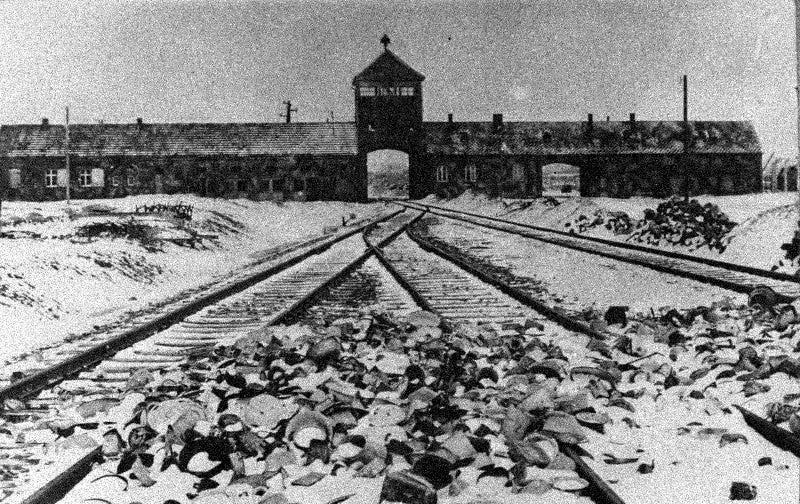
The central conflict here is not over Holocaust revisionism or denial. Tooze and Postone both agree about the scale of killing in the Holocaust and the centrality of anti-Semitic thought to Nazi ideology. But in Tooze’s critique, Postone and others simply looked at the surface of things: six million Jews murdered, the use of trains, the presence of incinerators, the timetables and punchcards used to track the numbers to be transported, enslaved, and killed. They held these signifiers next to one another to find a certain kind of poetic meaning without delving into the concrete details of the objects themselves. Timetables and trains are modern, the burning of industrial waste is a factory process, Auschwitz has train tracks and factory-like smokestacks, etc. Postone and his contemporaries then placed these objects next to one another and read them as evidence that the Holocaust was carried out via the technologically-advanced industrial project of the Third Reich.
Tooze, as a historian focused on political economy, takes a deeper dive into what the timetables and camp inventories actually say and comes up with a very different story. The Holocaust was, in the context of the activation of the German war economy, carried out with comparatively few resources, taking little from the rest of the war effort, and representing very little investment in new modes of killing, outside of the use of new chemical agents. The crematoria were technologically not very advanced for their time. The number of train cars needed for the effort of murdering 3 million people in the camps came to less than one-tenth of one percent of the number of train cars needed to move troops and supplies to the front. The three million Jews killed outside of the camps were mostly killed by hand, with guns—a far cry from the hyper-efficient death machine that Postone and others portray.
The failure of Postone and others to look at the actual numbers, to dig into the nitty gritty of the war economy and the Holocaust’s place in it, creates an image of a Holocaust that wasn’t—a high tech horror where technology and modernization are the principal features of the dehumanization of the victims. This obscures the Holocaust that was—a brutal, messy, mostly technologically crude operation made feasible by the immense scale of the German war economy; a project that also served important economic functions within the larger Nazi projects of Lebensraum and mass genocide. Contrary to the caricature of the Nazi motivated by a purely “stupid” anti-Semitism, Tooze shows in his book, The Wages of Destruction, how the infrastructure created in carrying out the murder of Eastern Europe’s Jews was, however crude, intended to be expanded as part of a project of colonial expansion into Poland and Eastern Europe. The plan to populate eastern Europe with a new German peasantry was, in the minds of top Nazi Leadership, the route to securing the German food supply. By the Nazi’s own accounting, this would have involved the deaths through starvation, displacement, and slave labor of an additional forty million Polish and Slavic people.
How did Postone, who saw himself as encouraging the Left to look unflinchingly at actually existing Nazism, get lured into a way of looking at the Holocaust’s surface phenomena that ended up obscuring a more accurate political understanding of Nazism and its projects? Following Tooze, we could say that Postone’s approach represents a fashion for looking at Nazism as if it were a combination of brutality and advanced machinery—an essentially pre-political understanding of the Nazi project. This reading ends up inadvertently buoying the post-war self-presentation of Nazi leaders like Armament Minister Albert Speer, who presented himself as a brilliant technician, not particularly focused on the nonsensical ideological parts of the Nazi project, who was just very good at getting an advanced war machine to run as efficiently as possible. Such an understanding enables the Nazi leaders to present themselves as capable and intelligent, yet “play dumb” where political and ideological motivations are concerned. This, Tooze shows, conceals the fact that Speer and other sophisticated architects and engineers of the war and genocide were constantly finding ways in which plans for the war, genocide, fulfillment of labor demands, and mass starvation schemes could support one another.
One psychological dynamic that may have contributed to this image of the “pre-political Nazi” is the need within the mind for one’s adversary to be stupid. Postone and other left intellectuals of the late-twentieth century were likely as vulnerable as we are today to wanting their political enemies to also be their intellectual inferiors. The quickest route to this self-conciliatory conclusion in the case of the Nazis is to say that anti-Semitism makes no sense. But it is not enough to say that an idea doesn’t make sense simply due to its lack of explanatory power, its moral repugnance, or its reliance on scape-goating. For something to be really stupid, it also can’t make any economic sense; in fact, following it must be the road to economic ruin.
There was thus a psychological seduction to the belief that anti-Semitism and pursuit of the Holocaust harmed the Nazi War effort, as opposed to a recognition that it was carried out at a marginal cost within the context of the war and served economic and political functions within the war effort itself. One’s enemy is much more terrifying if they can consciously and on the cheap use a genocide of six million Jews to lay the groundwork for a genocide of an additional forty million people.
There may be another psychological factor at play here as well, though. Often, when people seek psychological treatment because of harm done to them as a child by another, there is a moment when there is a disturbing realization: that while the harm the patient suffered was deeply wounding, the actions taken actually received very little of their persecutor’s resources. When the thought occurs that someone or something else got most of their persecutor’s actual time and energy, a person is able to move from an anxiously persecuted sense of themselves in the world to contending with a somewhat sadder reality that while they were indeed harmed, it didn’t take much from the other to harm them. When an injury has been materially central to one’s identity formation, it can be hard to let go of the wish for it to have been centrally important to the material well-being or the material downfall of the injurer.
When identity is the reason for a form of oppression, a narcissistic injury is formed that can make any of us vulnerable to reading our oppression as central, even structural, to our enemies’ social organization. The fantasy develops that by engaging in our oppression, our society either dooms itself, or perpetuates itself. Sometimes, however, oppression does not determine the functioning of an economy, but is something like a pilot project carried out with what is scrappy and underdeveloped in an economy characterized by “uneven and combined development.”
Benjamin Fife is a psychologist working and teaching in California. He writes about psychoanalytic theory, clinical practice, politics, and history.