

Foaming for Breakdown
YouTubers documenting their Amtrak journeys unwittingly offer a sad window into American decline. But they’re also keeping the hope alive that the US might see the infrastructural renewal it needs.


This essay is from our sixth (and final) print issue, “Trains,” which is out now. Order your copy here.
Tonio Guajardo’s twenty-one-and-a-half-minute YouTube video, “I Took America’s Worst Possible Train,” is a rare instance of clickbait delivering on its promise. The video’s premise is simple: travel across the country—from Miami to Alaska—via public transit (no planes or cars). This mostly meant riding Amtrak, the unsaid but obvious referent of the video’s title. Still, the idea holds a certain romance: taking in the country’s majestic landscape by train, as Americans did a century ago. Not everyone would sign up for it, but how bad could it be?
Four minutes into the video, Guajardo heads to the train’s dining car for a burger, in which he finds a hair. He eats it anyway. Moments later he discovers he can’t shower because the shared bathroom is stuffed with janitorial supplies. Later, he heads back to the dining car only to learn that it’s closed. Apparently the train’s electricity had been shut off after the café car caught fire and, in what becomes a mantra of his trip, he’s told there will be a delay. Remarkably, that is not the only instance of fire. Faced with another bout of flames, the train runs a whopping sixteen hours late.
But hey, you can’t keep a YouTuber down—especially when there’s great content to be made! Undeterred, Guajardo spends his time befriending fellow riders, especially his valet (apparently you have access to a valet if you book a private or semi-private room; that’s nice!). In typical can-do content creator fashion, Guajardo takes pains to explain to his audience that, sure, this is all annoying, but isn’t life really about the friends you make along the way?
“I Took America’s Worst Possible Train” has over three million views, because stuff like this is perfect fodder for internet addicts like myself, who enjoy watching strangers merrily traipse across the globe. And there is no adventure more unpredictable, no mode of transport more unreliable, than America’s rail service. This may partially explain why “Amtrak sucks” videos have enticed a growing community of “foamers”—a term for train enthusiasts so passionate they’re said to foam at the mouth—who delight in watching content creators suffer every fresh indignity visited upon American rail.
There’s a masochism inherent in being an Amtrak-YouTube fan. Even the sweetest “The Most Scenic Trains in North America”-type videos, which promise sweeping views of America’s sublime landscape, can’t help but highlight the truth about Amtrak: its trains are old, its accommodations are lacking, its tickets are expensive, its food (assuming you’re lucky enough to get some) sucks, and, above all, you will be late—and not just a little late, but, like, really late.
What’s saddest about “I Took America’s Worst Possible Train,” and indeed many of the subgenre of “Amtrak is terrible” videos of which Guajardo’s forms a part, is that Guajardo went into the trip knowing it was going to be terrible. Like so many of us, his expectations were low—maybe not as low as they should have been—but he certainly didn’t expect five star service. He didn’t believe that Amtrak was capable of providing a good trip, or even an adequate one. You can’t let a man down who has no expectations in the first place.
And that’s the most tragic thing about Guajardo’s experience: he isn’t really bothered by the many mishaps that plague his journey. If people used to speak about an “American Century,” in which, to quote the publisher Henry Luce, the United States “would become the powerhouse from which the ideals spread throughout the world… lifting the life of mankind from the level of the beasts to what the Psalmist called a little lower than the angels,” today we’ve come to expect a hair in our burgers. The American century of humiliation has begun.
What Never Could Have Been
The failures of Amtrak, like the failures of so many of our nation’s utilities, aren’t simply accidents. They’re the result of privatization, chronic underfunding, and deliberate policy choices that prioritized cars over trains. Seventy percent of America’s train tracks are privately owned, which is one of the reasons why passenger trains are consistently late. While federal law requires freight companies to give right of way to passenger trains, track owners routinely ignore the rule. The problem is compounded by the freight companies themselves, who have increased the length of their trains to maximize profits. These longer trains mean longer wait times for passenger trains, increasing delays across an already-busy network. As a result, more than one-in-four Amtrak trains are late to their destination, a number that climbs to sixty percent for long-haul routes like the Southwest Chief.
The United States used to be the world leader in rail service. The country was once traversed by some 254,000 miles of track, used for both passenger and cargo service. Today, we’re down to 140,000 miles of freight rail and just 22,000 miles of passenger rail. The decline coincided with a dramatic fall in passenger train use, as cars—which, after the construction of the Interstate Highway System, were able to easily traverse the nation—and planes—whose commercial use exploded after World War II with the emergence of a large middle class—quickly replaced rail travel.
In 1970, President Richard Nixon delivered the death blow to US rail service when he signed the Rail Passenger Service Act. Known for the birth of Amtrak, the legislation simultaneously removed the legal requirement obligating private railroad companies to provide passenger services. This left Americans with few options for rail travel. But even as one of the last passenger rail options, Amtrak had to fight to keep itself afloat by competing for Congressional funds and grants while pushing ticket sales for a lackluster product.
Amtrak continues to face an uphill battle. In recent decades, the company has been operating in the red. In 2019, Amtrak faced a $1.4 billion deficit, forcing the company to raise ticket prices while service quality deteriorated. Recently, Amtrak also introduced “dynamic pricing,” which, according to The New York Times, is “a system that rewards early planners and charges a premium for flexibility and last-minute travel.” This has resulted in riders reporting ticket costs several times the price of planefare or gas. Would you pay $572 for a round-trip ticket between New York City and Washington, DC? Probably not, but Amtrak wants you to pay that to travel it on the ground.
Assuming you do cough up the dough, don’t expect any frills. Most of Amtrak’s cars were built between 1979 and 1996, meaning that even the newest cars are at least thirty years old. If you’ve ever watched any of these Amtrak YouTube videos, the age shows: backed-up toilets, missing soap dispensers, and depleted water heaters are commonplace. And the horrors of Amtrak transit aren’t limited to the cars themselves.
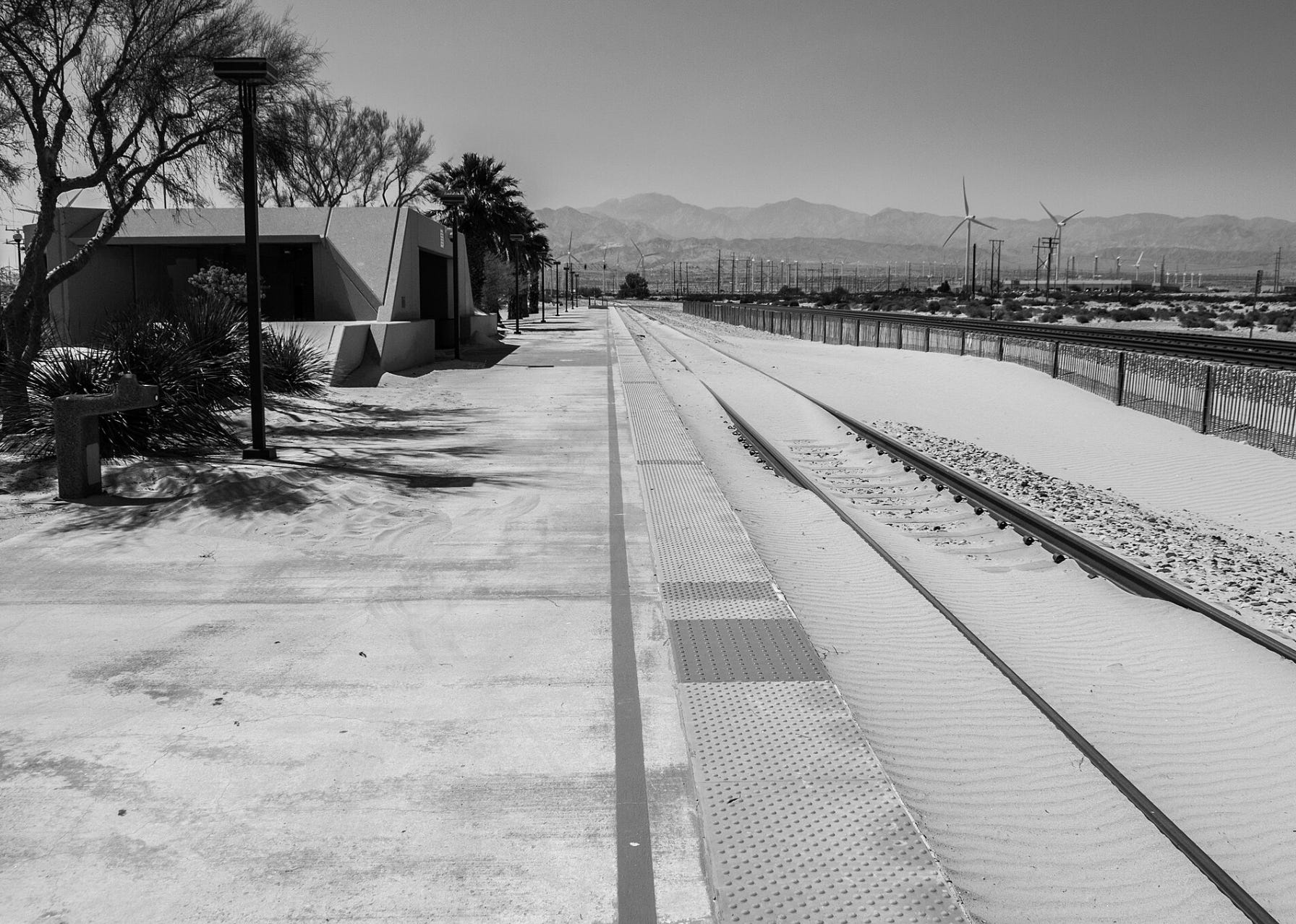
Take, for instance, the YouTube channel Fourth Place’s video, “The Amtrak Station in the Middle of Nowhere,” about the inexplicable placement and near unusable condition of Amtrak’s Palm Springs, California station. The station is miles away from downtown Palm Springs. As Palm Springs has no bus service, the only way to get there is to drive or walk miles through the Sonoran desert. But don’t worry: the station is not only underutilized, it’s been effectively condemned since 2021, due to the completely predictable and well-known sandstorms that are a constant at the border of the Sonoran and Mojave Deserts, where Palm Springs visitors and residents have made their peace with choking on a haboob now and then.
One wonders what inspired Amtrak’s planners to build a station there. On a good day, it looks like the end of the world. When the roads are clear enough of drifts for a motorist to get to it, sand invades the outdoor shelter as dunes cover the walkways, benches, and tracks. The Palm Springs city government tried to build a wall to give parked cars some protection, but the wind just glides around it, depositing the sand anyway. The station itself is haunting. It’s not something that was and is no longer, but something that never could have been anything in the first place.
Only Six Minutes Late Is Almost On Time
So it’s fair to say our passenger train system is struggling. And these depressing scenes are made even more desperate when compared to other countries. The United States has exactly 0 miles of true high-speed rail. China, by contrast, has constructed some 30,000 miles. Even little old France, has nearly 2,000 miles. It turns out large-scale, modern passenger rail projects are possible—just not in the United States.
Amtrak is bad on its own terms, and it’s really bad when you compare it to rail service in other countries. Riding Amtrak is an exercise in voluntary suffering—if you’re not monetizing the experience like Guajardo, then the only point of it is the pain. I’ve only found one creator who’s mastered the art of enjoying Amtrak hell without the performance of pretending they’re in heaven: the always charming YouTuber Miles in Transit.
Miles genuinely loves riding on public transit. In fact, as he explained to me, he started his channel as an excuse to ride every bus and train he could—just because. Miles has embraced the “foamer” sobriquet, exuding genuine excitement as he shares his train-riding experiences with viewers. Only Miles could travel across the country, in coach, for days, and remain in good spirits.
At first blush, Miles’s chipper demeanor seems reminiscent of your typical content creator. But unlike other public transportation YouTubers, he never assures the audience not to worry. He may laugh at the five days expired Amtrak lunch, but he doesn’t romanticize it (and, yes, that really did happen to him). Instead, each of his rapid-fire, quick-cut assemblage-styled videos includes countless harrowing tales of American decay. Like the time he bemusedly filmed a bus driving away from a station just moments before the train—containing the people that the bus was supposed to pick up—arrived. Or the time when, in disbelief, he reported that Houston—the fourth largest city in the United States—“is only served by Amtrak three times a week.” Or the time he let us know that one Amtrak station has more overhangs to protect cars than overhangs to protect people. He regales us with these stories, smile intact, not because he’s performing for YouTube but because he’s a true foamer—one who documents American rail’s failures precisely because he believes they don’t have to be permanent.
Ultimately, then, Miles’s videos are not only about American decline; they implicitly suggest that there is a different world in which transit actually makes our lives easier. Miles never discusses this counterfactual world, but it’s evident in his unapologetic enthusiasm. He loves trains so much that he celebrates when one arrives only six minutes late. He leaves these small moments of triumph in his videos because they showcase that things could in fact be better.
Perhaps all is not lost for American rail service. Intriguingly, after decades of decline, Amtrak’s ridership just reached a record high, up over 50% since 2022. And the company hopes to reach some sixty-six million annual riders by 2040. This is a lofty goal, but not impossible. Officially, experts credit the increase in ridership to a post-Covid rebound, but the explosive popularity of new routes may point to a demand that has always been there, but was not being effectively supplied.
According to a recent Los Angeles Times feature on Amtrak’s “Southwest Chief”—a 2,265-mile, 43-hour train ride that, like Route 66 of old, takes you from Los Angeles to Chicago—“people like it” the way it is. There’s a lot to like about rail travel. There’s no TSA, it provides a break from the hurried pace of modern life, and you can get views of America’s landscape that aren’t available to the car bound.
As driving becomes more dangerous and work becomes more flexible, perhaps more people are willing to overlook Amtrak’s many pitfalls. Or maybe those pitfalls could even be reversed with proper funding. The 2021 infrastructure bill passed by “Amtrak Joe” Biden gave the service in just five years what it had received over its lifetime. As a result, the passenger rail service has promised new routes, new facilities, and—importantly—new cars.
But US history resounds with many an infrastructure promise withering on the vine. For now, I’ll keep watching train videos. The question remains whether people like Tonio Guajardo and Miles in Transit are documenting a permanent decline or a subtle comeback.
Courtney Rawlings is an art historian, critic, and host of the podcast Always at War.