

Everybody's Doin' a Brand New Dance Now
To the extent that dance crazes still exist, they aren't making them for the masses anymore.


This essay is from our sixth (and final) print issue, “Trains,” which is out now. Order your copy here.
The dread is minimal, but it’s there: that the train autists will read this issue and, if not rally the troops to swarm us with angry emails, then stampede r/trains and work each other into a mass frenzy, possibly resulting in strokes, heart attacks, or suicide. Since it is my sincere goal to prevent anyone from harming themselves or others, I will resist the temptation to reflect on my own family’s three generations in the Brotherhood of Locomotive Engineers and Trainmen. I won’t get misty-eyed about my mother’s—and later my—childhood cat, Chessie, named for the mother of the two sleeping kittens who joined her as the mascots of the Chesapeake and Ohio Railway, where some of the men I come from kept America moving, and whose face dons the vintage wool Chesapeake blanket thrown across the chair across from me right now.
And I won’t talk about my generous support for Los Angeles’s own Travel Town, an outdoor railroad museum—with tourable restored antique freight and passenger cars—where I dedicated a donation to my great grandfather—”Beloved husband, father, grandfather, great grandfather, and proud union man”—and whose name is now on the “Restoration Partners” plaque in the Travel Town Arcadia Depot. No, I will speak nothing of that, nor any of the other ways that trains love me more than they love you, you hissing little Deviant-Art freaks.
I’m just here to dance.
A People’s Dance
The transition from steam to diesel train engines began in the mid-1920s, and although there is some pedantic quibbling about what constitutes “retirement,” the 2006 issue of Canadian Pacific Steam places the final year of the steam engine locomotive in the US, save for a few passenger trains, around 1960.
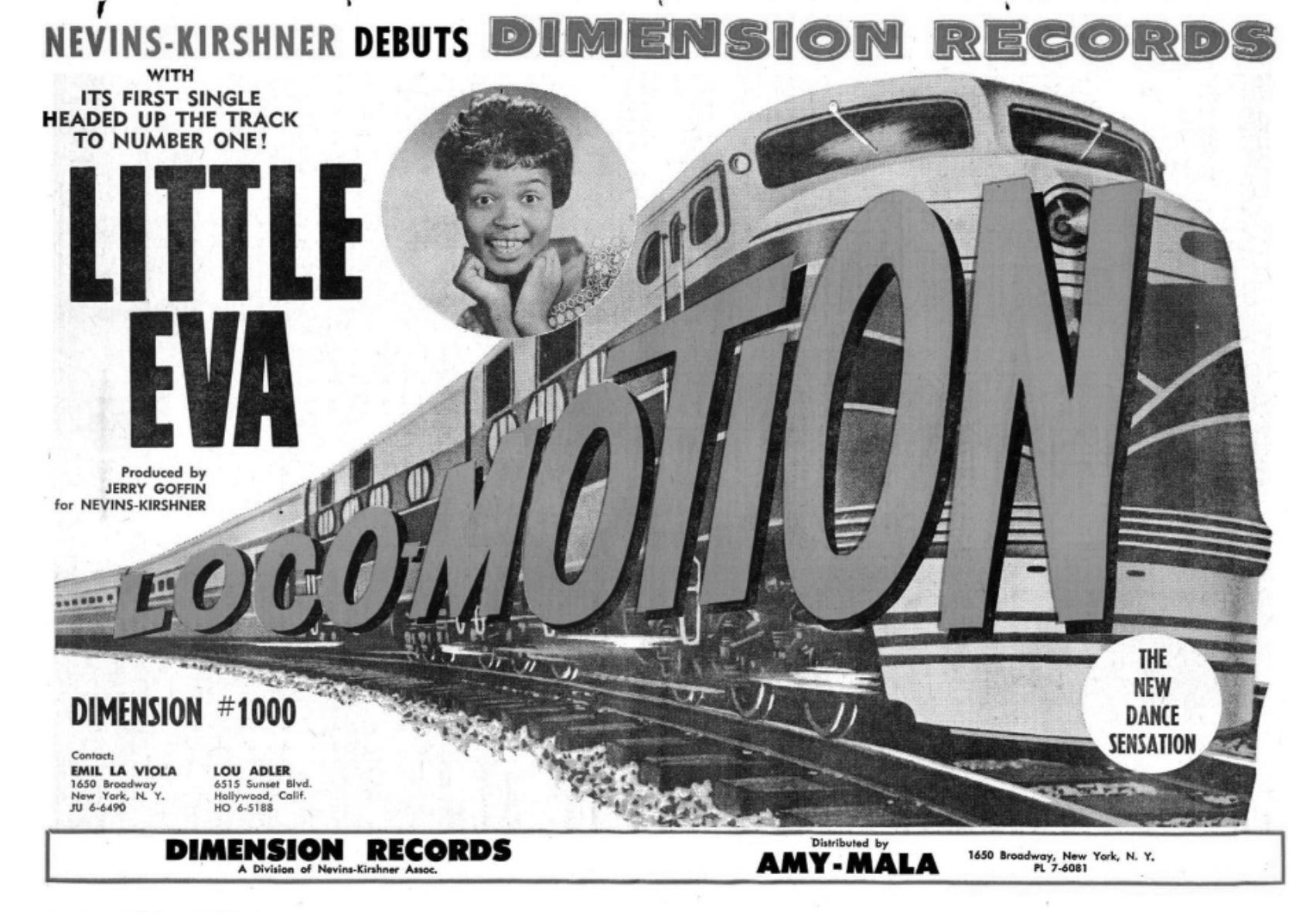
So when Little Eva sang “Come on, come on, do the locomotion with me” in 1962, the technology the dance was pantomiming was already anachronistic. You might assume the reference precluded its christening of a young dance. But you’d be wrong.
The arms, parallel and bent at the elbows, forming two right angles against the body, moved in a single dimension, the hands tracing ovals on either side of the torso, extending forward with the beat before taking an arc backward, like the rotation of the eccentric rod and drive and connecting rods that mobilize the wheels of a steam engine train (you know it’s a steam engine that’s being mimicked because the newer diesel trains don’t have eccentric rods). The Locomotion was as simple as that. Or as complex as you wanted it to be.
It’s what I refer to as a “Peoples’ Dance,” which involves four factors:
They travel well. Whether they originated in gogo clubs, dance halls, discotheques, or Tin Pan Alley, they made their way to the masses and eventually permeated popular culture. These are moves that move.
They’re “appropriate” in mixed company—at least eventually. There was outrage about “The Twist” that is now generally attributed to a combination of racism, a moral panic over “juvenile delinquents,” general prudishness, and—hand to god—public health concerns, with multiple doctors attesting publicly to the ostensible injurious harm potentially incurred by moving one’s hips. But all that burnt off pretty quickly. And while the Twist can be fun and slutty, its foundational micro-gyration is well-accepted as G-rated, unobjectionable to the minister’s wife in a way that twerking never will be.
They are done in public (though not exclusively), with more than one person present. If you see someone doing the dance by themselves, you’re looking at either the artist who popularized it, or a mentally ill person. Or you’re a Peeping Tom (shame on you).
And the most important one (this is essential): You do not have to be a good dancer to do them. Or even know how to dance. Improvisation and variations may be extremely advanced, but there is always, always an entry-level foundational move or moves that your mom could—and definitely did, at the Jones’s tiki barbecue after a few Mai Tais—perform with some proficiency.
Moving in Place
Around the mid-50s, America was leaving behind swing dance and it’s highly locomotive (yes, it’s an actual adjective) use of the floor, in favor of more planted, space-saving moves like the Mashed Potato, the Pony, the Bird, the Watusi, the Alligator, the Jerk, the Swim, and a whole bunch more, including the nearly forgotten Locomotion. Think about it: you remember the song, but have you ever learned the dance? Did you even know it was a real dance?
As rhythm and blues music mainstreamed, and Rock ‘n’ Roll began to dominate the radio, dance moves from black Americans were “toned down a little bit” for television consumption, along with desexualized adaptations of the 21-and-up urban night club go-go dancers, who generally weren’t actual strippers or topless dancers but were definitely still titillating enough to be scandalous. Go-go girls had to dance on tiny elevated stages for optimum visibility in a meandering barcrowd, a blocking method that also worked well for performers and dancers on TV, an increasingly common appliance in American households. Cameras kept close to the performer, and while faces were good TV, full body shots let you see how they moved. Sometimes they would even do close-ups of feet.
If you had dance halls or school dances, or just a conducive public space, you might learn to dance with your peers. If you didn’t, you could watch Dick Clark every Saturday at 3 and practice at home. In fact, your local TV station might have their own dance show, featuring local amateurs, just like you. And if you got good enough, you might be able to audition yourself, and be on TV, because if that girl from your rival high school over in South Baltimore can do it, why can’t you?
These new dances—or cutesy’d up old ones—were ready-made for teenybopper programming. A new shoe even came on the market, optimized for the moves, if you were willing to be a little scandalous: go-go boots, with their lower, thick, chunky heels, for a little bit of height and bounce, and virtually no tread, eliminating any friction that might anchor your feet and make it harder to slide or rotate your feet in place. Go-go boots weren’t prohibitively expensive, nor were any of the other fairly quotidian ensembles sported by the kids on American Bandstand and The Buddy Deane Show. You didn’t need a special wardrobe, equipment, or lessons.
You could learn to dance in your living room, right in front of a nineteen-inch TV screen, because while the dancers might be moving a lot, they were usually moving in place. Again, essentially, you didn’t have to be a good dancer! An awful dancer could make the Locomotion look good! And a great dancer could make it look transcendent, embellishing their interpretation to the level of fabulous choreography. But you could keep it bare bones, and no one would laugh at you.
And Little Eva was there pumping you up.
“My little baby sister can do it with ease
It’s easier than learning your A-B-C’s”
You got this! I mean the choreography is in the lyrics.
“Jump up, jump back”
You can do that! That’s as minimal foot movement as anyone could possibly ask of you, and we’re gonna’ make it look good, right? Right! Ok, let’s work the room.
“Now that you can do it, let’s make a chain now”
See what that girl in front of you is doing? Just do that. Actually, I think she’s looking at you for tips. You look like such a pro! Ok, now, don’t forget your hands.
“A chug-a chug-a motion like a railroad train now”
If you feel like challenging yourself, and maybe shootin’ yer shot—no pressure!—you can throw this one out to impress that chick in the slutty go-go boots!
“Do it holding hands if you get the notion”
For a moment, everyone, everywhere, could dance. Then we switched trains.
