

China’s Rail Revolution
An interview with Chinese technology analyst Dan Wang on the remarkable development of China’s high-speed rail network


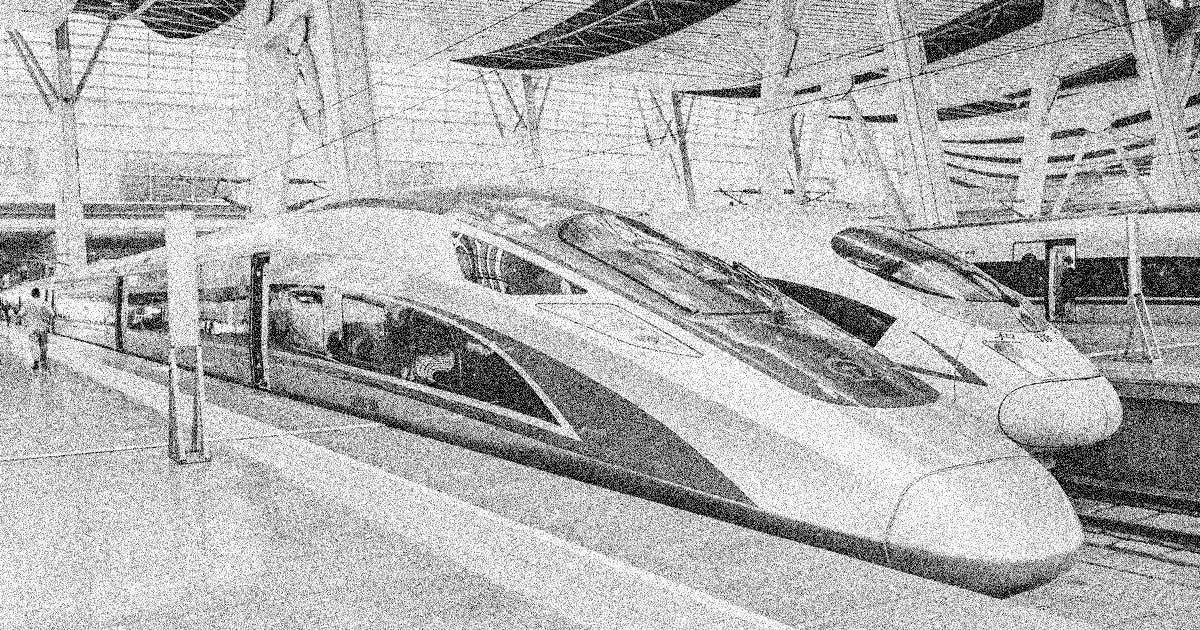
This interview is from our sixth (and final) print issue, “Trains,” which is out now. Order your copy here.
Just two decades ago, China had no high-speed rail network. But today, China boasts the largest high-speed rail system in the world, making up more than two-thirds of the global total by kilometers of track. The US, by contrast, has been completely incapable of building at all. Despite California’s successful vote in 2008 to build a high-speed rail line in the state, there is none yet in operation after nearly two decades of administrative wheels turning. In his recent bestseller, Breakneck: China’s Quest to Engineer the Future, analyst Dan Wang conceives of China as an “engineering state” that builds rapidly with abandon and the US as a “lawyerly society” that blocks all change, good and bad. We sat down with Wang to understand how the Chinese engineering state’s high-speed buildout of high-speed rail. This interview has been edited for clarity.
Daniel Cheng: Your book, Breakneck, is centered around your novel conception of China as an engineering state. What is the engineering state, and how does it relate to China’s high-speed rail system?
Dan Wang: The engineering state is a state run by engineers. Throughout the 1980s, Deng Xiaoping decided to promote many engineers into the top ranks of the Central Committee as well as the Politburo. And what do engineers like to do? Build a ton of shit. My book is about how China in the last 40 years has really engaged in this giant spasm of construction. China has built homes, highways, bridges, solar, coal, wind, and a lot of high-speed rail as well. China started its first line in 2008 and completed it three years later, linking the megacities of Beijing in the north and Shanghai in the east. Over the next 15 years, it built a high-speed rail network that is 15 times the length of Japan’s. It now has two-thirds of the total amount of the world’s high-speed rail track.
DC: China today is still a middle-income country. When it started building out its high-speed rail network in 2008, it was even poorer measured by GDP per capita. How did a relatively poor country build out such a massive network so quickly?
DW: In part because they’re an engineering state. When they attempted to build this high-speed rail project in 2008, there was a lot of skepticism from economists because China was still a lower middle-income country by World Bank classifications, and they didn’t think China needed this sort of project. But China decided to do it anyway in part because the country was trying to grapple with the Global Financial Crisis, just as everyone else was.
The railway minister at the time was a highly entrepreneurial figure who told the Chinese leadership that this is exactly what we need at this moment. He ended up being so corrupt that the state claimed that he had fifty mistresses, and he was sentenced to death with a reprieve. But despite his corruption, he drove this process forward in a way that surprised much of the leadership. The state had just released the 12th Five-Year Plan, which actually had no provisions for high-speed rail. So it became a kind of economic emergency measure pushed by this highly entrepreneurial guy as a way of dealing with a financial crisis. That was the primary political factor at play.
But the economic factor is that a lot of these economists were wrong about China not being suited for high-speed rail. China actually was a good candidate at the time because it had long underinvested in rail infrastructure. When they invested in high-speed rail, they could free up a lot of [their existing, lower-speed] network for commercial freight. That doesn’t mean that it remains a good investment to build more high-speed rail today. The engineering state can’t stop. But for a while, it was a good investment.
DC: In the West, we often hear stories of China overbuilding its high-speed rail system and bleeding money on unnecessary white elephants and unused train lines and stations. Do you think that’s a fair characterization?
DW: According to a World Bank study completed a few years ago, the system on net makes money. On a narrow economic basis, the conclusion of the World Bank was that the system has been able to pay for itself. And then there are the non-pecuniary benefits of having an extensive high-speed rail network, which is that there seems to have been higher rates of innovation as measured by patent filing along cities that are connected to the network. Now, there are all sorts of non-pecuniary costs with building high-speed rail, namely displacement of people, destruction of the environment, and these have to be tabulated as well. But strictly from a pecuniary standpoint, it seems like this has been a good investment.
But when engineers are in charge, there’s also the political benefit of high-speed rail. High-speed rail was not purely an economic project with purely economic costs and benefits. Extensive infrastructure is also a political project. China can declare to its people: “Look at our gleaming infrastructure, you’re able to get around the country easily. This so-called rich nation, the United States, plus the so-called wealthy province of California, are unable to connect San Francisco and Los Angeles. In addition, it’s unable to connect them decades after this democracy delivered a referendum that the state must build a high-speed rail line.”
But unlike high-speed rail, China’s really tall bridges in places like Guizhou are losing money, and the state has trouble meeting its bond payments. They really are uneconomical in a strictly pecuniary sense. But the state takes a longer term view of these projects. You might be building a bridge to nowhere. But after you have a bridge, maybe two nowheres become two somewheres. When the state declares that they’ve transformed transportation times from three hours to three minutes, villagers feel good about these time efficiencies. They feel like they’re part of a growing, thriving, strong country. Frankly, I think that’s something that states everywhere ought to deliver to their people.
DC: What about the social costs of China’s high-speed network? Could you talk a bit more about displacement, environmental damage, and any other such costs that we should be aware of?
DW: I’m not sure how many people the high-speed rail network displaced. When it comes to something like hydroelectric dam projects, the figures for something like the Three Gorges Dam, the world’s single largest power station, are hundreds of thousands of people displaced. People simply moved higher into the mountains because their valley had been flooded by the reservoir that the Three Gorges Dam created. Roads often require displacement, though this doesn’t always happen. For example, if there’s a farmer who doesn’t want to move, they build the roads around the farmer’s house and these are referred to as “nail homes” because they stick out like nails. That’s sometimes taken as evidence that the state does not have full power to actually displace everyone. The reality is somewhere in between.
For certain major prestige projects like the Three Gorges Dam or high-speed rail, the central government will not suffer anyone to put up a home in the middle of the train tracks. So human displacement is definitely one cost. Not everyone wants to move high into the mountains to eke out a living on mountain land. There is also an environmental cost in terms of the ecologies that are rammed through with concrete and steel. There’s a carbon cost because concrete and steel are very carbon-intensive. These are all trade-offs. And then the only question is how do we judge these costs against the actual usage of high-speed rail, which has delivered value as well.
DC: What’s been the Chinese public’s response to its high-speed rail network? Do people like taking it?
DW: People really love being able to get around relatively cheaply and comfortably. Even though flying between Beijing and Shanghai is faster, plenty of people prefer to take high-speed rail, enjoy the extra space, and do some work on the train. I was taking it pretty extensively from Shanghai to Hangzhou and Suzhou. Hangzhou is now China’s major AI center, and Suzhou is one of China’s big manufacturing hubs. Being able to take a train to these big cities from Shanghai felt great. I loved that I was able to take my bike on the train to go to Guizhou. It took about 7 hours, but it would have been much more difficult to take a bike on a plane.
Generally what I’ll say is that transportation and logistics in China are really amazing. It’s not just the trains too. The airports work very well; there’s very few flight delays. The highway system is excellent. When you order something on China’s equivalent of Amazon, there’s usually next-day delivery even across the country, because the trucking system is fantastic. You can hop on these ride-sharing bikes and easily get around the city. For a 20-minute ride, you’ll spend something like seven US cents. You can order a croissant from a bakery in Beijing, and it would be delivered to your home in 30 or even 15 minutes, which is fairly difficult to do even in New York. Ease of mobility is really excellent in China and that feels brilliant and exciting when you’re there.
DC: You’re known for your memoiristic writing style. Having lived in China for several years, what was your personal experience on Chinese trains like?
