

Brazil Off the Rails
The train, for Brazil, is a fairytale: a fetish, not a transit solution; an image of a past modernity, now turned quaint, not a vision for the future.


This essay is from our sixth (and final) print issue, “Trains,” which is out now. Order your copy here.
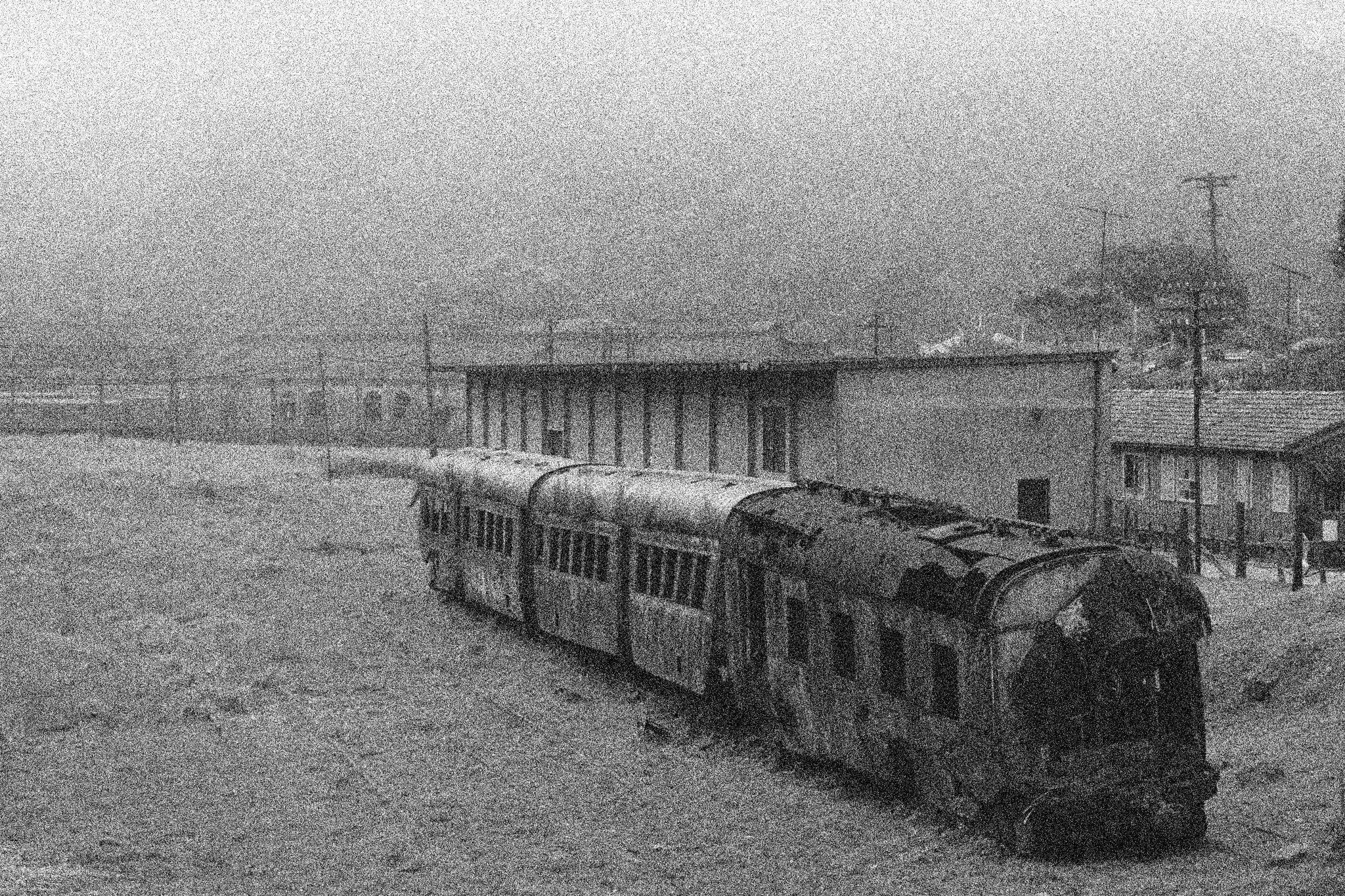
Paranapiacaba is almost permanently shrouded in fog; maybe the Victorian Englishmen who worked in the town would have felt right at home, were it not for the mountains and the dense Atlantic rainforest—denser than the Amazonian—and the humidity, the bugs, and so on. The railway village, built in the 1860s by the São Paulo Railway Co., would thirty years later put up a Big Ben-style clock tower at the station. It’s unclear whether this represented a symbol of modernity or civilization to passers-through back then, but today it looks both tacky and iconic, out of place but evocative.
Paranapiacaba is perched 800 meters up on the scarp of the jungle-covered Serra do Mar mountain range and means “place whence one sees the sea” in Tupi-Gurani. Below it at sea-level is the petrochemical hub Cubatão—in the 1980s one of the world’s most polluted places, generative of health problems so severe babies were birthed still-born. Beyond this erstwhile “Valley of Death,” on an island facing the open ocean, is Santos and its port, today the largest in Latin America but one which barely sneaks into the global top 40 of maritime hubs—a fact indicative of the region’s diminished global economic standing.
Paranapiacaba was built to house workers and engineers on the railway, which was built to transport coffee, whose agriculture was then booming—an economic dynamism based on commodity production and export, the use-values of which would pass through Santos on its way to Europe and North America.
From the Santos lowlands, the tracks scaled the Serra do Mar through a funicular railway and rack and pinion system, and continued onwards, through São Paulo’s eponymous capital (50 km inland) and on to Jundiaí (another 50 km). On its way up, it carried millions of Italian, Portuguese, Spanish, German, and Japanese immigrants who would work on the coffee plantations and other farms, and eventually in São Paulo’s burgeoning manufacturing industry. Indeed, that train line stopped in Brás, central São Paulo, where a guesthouse functioned as the first place of arrival for migrants: Brazil’s Ellis Island. Like Paranapiacaba, the disused train station and its environs now hosts events and festivals, serving educational and memorialization functions, a part of the industrial-heritage industry.
Road Over Rail
The birth of Brazilian railways is evocative of the country’s colonial mentality, even decades after independence. As Odilson Nogueira de Matos explained in his noteworthy Café e ferrovias (1973), it was the English who primarily built the railways because “it was madness to suppose that a Brazilian could be the initiator of such an undertaking. There was no capital, no men, nor could there be ideals in a commercial and industrial body whose base of operations was the importation of slaves from the coast of Africa.” It took the 1850 Eusebio de Queiroz law restricting the slave trade to free-up capital to for the first railways to be built, before the British came in with more significant investment and know-how.
Brazil’s first railway was inaugurated in 1854 and from the 1870s the country (or at least the southeastern state of São Paulo) experienced “railway fever,” as the imperial government guaranteed returns of seven to ten percent over declared capital. But rail was not actually a pioneer, as it was almost everywhere else in the world. It did not open new frontiers but rather accompanied those being cleared by coffee. “Built to serve the interests and conveniences of the farmers,” Matos explained, “the São Paulo railway network, in its arboreal aspect, gives us today the impression of a total lack of planning, which explains why, once the economic basis that motivated it was overcome,” the railway decayed. Rail in Brazil was just a means of getting raw materials out of the country. Corridors generally run West to East, draining out to sea. There was no attempt at building an integrated network, only at funnelling wealth out. The agrarian elite responsible for railway fever had no interest in a strong internal market nor in national integration, which resulted, for example, in a range of different track gauges adopted across the country. It was the political fragmentation of the First Republic (1880-1930) manifested in iron.
The contrast with the US is stark. As Noam Maggor has observed, “What set the US apart from other peripheries was the capacity of the state, empowered by a mobilized agrarian population, to politicize economic policymaking and harness capital in favor of broad developmental priorities.” Organized agrarian interests drove regulation that balanced less-profitable local rail against long-distance trains, whereas in Mexico—though this applies, mutatis mutandis, to Brazil—one would see peasants walking alongside rail lines, rather than being carried upon them. This disregard for local service “contributed to a pattern of uneven development, with a few booming import and export hubs surrounded by vast areas of poverty. Comprador elites, embedded in existing extractive sectors and trade relations, helped defeat political efforts to remake these economies along more balanced lines.”
The 1929 economic crash was also coffee’s bust, and in turn that of the railways that conveyed the beans to ports. Getúlio Vargas’ nationalist government, brought to power by the 1930 Revolution that put paid to the oligarchy, reflected its Bonapartist homologues elsewhere (FDR, Mussolini…). But the nationalization of railways here was more of a bailout, a rescue operation to ward against the knock-on effects that abandoned or bankrupt railways would have across the economy.
Already in 1928, Washington Luis, the last president of the Old Republic, had signalled a change in direction: “To govern is to open roads” he declared, inaugurating the Rio-Petropolis highway, symbolizing a new idea of progress. The corporatist Vargas era that followed (1930-45) centralized the management of railways at the same time as laying the groundwork for the pivot to road, made good upon by Juscelino Kubitschek’s modernizing government (1956-61), which promised “fifty years in five.”
Kubitschek enticed General Motors, Ford, and Volkswagen to set up factories in Brazil through policies such as tax exemptions with stringent local component criteria imposed in return. The automotive industry has a more important multiplier effect than rail, and employed skilled labor to a degree that had not existed in Brazil until then. Moreover, road rendered more immediate political benefit than rail: it was quicker and cheaper to build, explains Talita Lessa Melo, a researcher into the past and present of Brazilian railways, and it sold a vision of speed, autonomy, and popular accessibility. Throughout the developmentalist 1930-80 period, the roadway simply offered more possibility than rail. It was a fortuitous confluence between capitalist interests, developmentalist vision, and a sellable idea.
It was then that the country built and inaugurated a new, modernist capital, Brasília, on a plateau nearly 1000 km inland of the old capital, Rio de Janeiro. The country was undergoing industrialization and urbanization at a blistering pace, and the working class’s share of income was rising. “Centuries ago, cities were built where men decided to stop. Today, man decides where he wants to build,” a government brochure declared. Pointedly, the New Yorker’s story on this “fitting symbol of the country’s future” was entitled “Man Decides Where.” But it was the elevated bus station that served as the centerpiece of the new capital’s non-governmental architecture, not a rail terminus.
The military dictatorship that seized power in the 1964 coup and held it until 1985 rode through the 1973 oil crisis, doubling Brazil’s bet on the car, through oil exploration and the massive expansion of the sugarcane ethanol industry in 1975. What investment in rail was left ended up serving as an argument against it: delivery of the giant Ferrovia do Aço (steel railway) was promised in 1000 days, but it was never completed, consolidating the notion that rail was costly and impracticable.
By the time the Brazilian growth machine halted at the start of the 1980s, the network was in terrible shape, and then came neoliberal counter-reforms which dealt their usual coup, especially once the reins of government were handed over to civilians to do the dirty work. Rail was privatized, the network was disaggregated and fragmented, and new concession-holders were divested of any obligation to invest. Cross-subsidization of less profitable lines was ruled out, so rail persisted as a means to transport soy and iron, while the rest of the network decayed even further.
Today, rail is controlled by big agribusiness, mining, and financial interests; it is only built where it is profitable and ownership is hugely concentrated. Rumo Logística owns about half the network (14,000 km); Vale—formerly a state-owned enterprise set up by Vargas, today one of the biggest mining companies in the world—owns another 2,000 km. Many lines have extremely slow operation speeds, made worse by the occupation of lines by poor communities—a favelization that speaks to yawning developmental gaps in the country. Passenger rail is at best 4% of the network—mainly urban commuter trains and a few lingering tourist trains going nowhere important. It is another snapshot of Brazil’s exemplary “premature deindustrialization”—a shift to services at income levels well below those of Britain or the US when they underwent similar processes.
Iron Fetish
From 1900 to 1980, Brazil averaged economic growth of over 5 percent per annum (3 percent on a per-capita basis), accelerating to 7 percent in the 1950-80 period, making it the fastest growing country in the world after Japan. It was an icon of modernization, but anyone predicting then that this “country of the future”—as Stefan Zweig had dubbed it a decade before—was getting there on iron tracks was greatly mistaken.
In many other countries, rail is rightly associated with industrial progress and modernity. But in Brazil’s growth period, roads had already supplanted rail. Rail never led; it merely followed, and then limped along. It was never an agent of national integration, and is barely even a memory anymore.
Still, rail, unlike other industrial structures, sticks around. Brazil has no good reason to be wistful for rail, but while the rest of the brick and iron remnants of manufacturing are gone, rail and railroad structures still stand. According to Eduardo Romero de Oliveira, a professor at UNESP and coordinator of the Memorias Ferroviarias (Railway Memories) project, this makes the railway iconic and idealized, even if it deserves neither.
The more extensive passenger rail of the early twentieth century was a means of conveyance in a still mostly rural Brazil, carrying people from small town to small town. The urban Brazil that emerged from the 1960s on had less need for inter-city passenger rail. Today Brazil is 86% urban, and over half of the population lives in mid-size to large cities.
The city of Rio Claro is exemplary, for Oliveira, of an ambivalent relation to rail. It is a “small” city (population: 200,000) in the agricultural interior of São Paulo state. The old Companhia Paulista trunk line runs through it, now serving freight coming from the agribiz heartland of Goiás. “Modernity” is to be found in that agroindustry—technologically advanced, hugely capital-intensive, Brazil the world’s breadbasket…—but in a way that “does not touch the lives of ordinary people.” Residents complain about the traffic-generating level crossing, but when asked if passenger rail should “return,” they think the idea “great, lovely, cute.”
This is probably inspired by memories of riding a Maria Fumaça—the steam locomotives that long ago earned the nickname “smoking Maria”—at one railway heritage site or another. Or there’s the fact that the first line of the book all Brazilians study in school, Dom Casmurro, by the literary master of the periphery, Machado de Assis, starts off with a reference to an unexpected encounter that happens on a train. Already in 1975, Milton Nascimento, one of Brazil’s most celebrated musicians, released a track called Ponta de areia, in which he laments the abandonment of the Estrada de Ferro Bahia e Minas line which had run from 1882 to 1966. They ordered the railroad to be torn up / The old machinist with his cap / Remembers the cheerful people who would come celebrate it / The steam engine doesn’t sing anymore. If that was nostalgia then, today Brazilians can only be nostalgic for nostalgia—akin to the third stage in Baudrilliard’s terms of distance from the real, where the sign masks the absence of a profound reality.
So when the residents of Rio Claro inveigh against the state’s dereliction of duty for not sustaining railway transport, Oliveira hears something else: words that don’t sound genuine, that are more like a repetition of someone else’s, the thing you’re supposed to say.
The train, for Brazil, is a fairytale: a fetish, not a transit solution; an image of a past modernity, now turned quaint, not a vision for the future.
Do, Just Do
Business mouthpieces love to go on about the Custo Brasil, the high cost of doing business in Brazil associated with the drag created by labor legislation, trade unions, public bureaucracy, taxation, and so on. These complaints are usually about cutting workers’ entitlements. But they also, rightly, concern underdeveloped infrastructure. If 61% of all cargo is being trucked around a continental-size country by road (75% when you discount iron ore), that would seem to be an easy target for upgrading—through rail. The fact that it isn’t speaks to an economic irrationality from the perspective of capital itself; a failure of the state to act in the interests of capital in general.
Talita Lessa Melo puts this down to the force of “rodoviarismo,” or highwayism, an entrenched commitment to the road and automobile and all that is associated with it. But we should look beyond isms. The reality is that there are a lot of vested interests in road, notably road-builders and bus companies, and truckers and their bosses. The last of these brought the country to a halt in 2018, in the lead-up to Bolsonaro’s election, in a divisive, politically ambivalent nationwide strike over fuel costs. But again, there is a greater rationality here—the efficiency of rail—which should have buy-in from business interests. Those that prevail, though, are those like finance and the extractive industries, interests that are directed outward, not inward to national development.
Some steps are being made at rationalization, such as the Legal Framework for Railways (2021), which facilitates private investment in the construction of railways and in the use of idle stretches of existing lines. 11,000 km of projects have so far been approved. But this is merely accelerating down the same track of facilitating commodity exports—or as one study put it, it is “reinforcing the market power of incumbent operators and failing to significantly promote intramodal competition or cargo diversification.”
Meanwhile, the 400 km span between São Paulo (metro area population: 23 million) and Rio de Janeiro (14 million) remains unconnected by high-speed rail (HSR). The line has been projected since the late 1980s—and talk ramped up in the lead up to the 2014 World Cup and 2016 Olympics—but without so much as a spade having been buried into the ground. Construction of the latest project, conceded to private company TAV Brasil and aiming for 300 kmh speeds, was due to begin in 2027. It has now been pushed back a year, with the Workers Party government careful to emphasize that this is a purely private project (a global rarity in such ventures), in turn drawing complaints from TAV Brasil about lack of state support.
More significant is the fact that the global winds are changing: state capitalism is the coming order of the day. Megaprojects are back, and with it, rail-building. But evidence of a change in mentality in Brazil is still very sparse. There is the small, if growing, camp of neo-Stalinists eager to “do a China” in just about any area of policy, but they have little institutional representation. And the fact remains that Brazil is the only non-signatory to China’s Belt and Road initiative among large Latin American countries, together with Mexico. The current planning minister’s enthusiasm for a rail link through the Amazon to Peruvian ports is just a means of selling more commodities to China, not some imitation of its deep and wide infrastructural investment. If backward-looking train nostalgia drives no political action, neither does future-oriented rail build-out.
Of course, China’s own massive build-out of rail is not easily replicable elsewhere, and would not even be economically justifiable in China, without the huge amounts of excess capital that the state can mobilize. But once you have it, you have it. And what China has done is undoubtedly astounding, a marvel of capitalist development. It is a vision of modernity—understanding the network as an integration project—that has been adopted both East (China) and West (Europe); it is a yardstick of development, one by which countries such as Britain and even Germany now measure up poorly. France, which kept rail under state ownership and invested in its network, came out the other side of neoliberalism much better off. A similar story could be told about its nuclear power plants. For Tim Abrahams, host of the Superurbanism podcast, historical vulnerability (Alsatian coal might be taken by the Germans!) cultivated a planning culture of not relying on one thing.
This is an important lesson. Brazil needs to upgrade its infrastructure in toto. What, for instance, is the role of electric vehicles (EVs)? As Benjamin Bradlow, a Princeton scholar studying Chinese EVs in Brazil points out, EVs may not represent futurity in a conventional way, as a transport revolution, but rather as a geopolitical one. For instance, Chinese automakers, led by BYD, are investing heavily in Brazil, to the tune of $1 billion to establish manufacturing, including in electric trucks and buses. Brazil, increasingly talked about as an energy superpower, with ninety percent of its matrix from low-carbon sources, stands to do well out of this new disposition. This is especially the case if claims prove true that electrification is the avatar of the new in a way exceeding whatever small developments there may be in means of transportation.
So it is a matter of doing more, not of never building another highway until a high-speed passenger rail network is built. Britain’s vexatious inertia over building HS2 connecting London and Birmingham is a case in point. It may not be “economically justifiable” in the narrow sense, but the act of delivering such a project proves to the state and citizens both that such a thing is possible, and creates a demand for more of it—and more importantly, it builds capacity. There are those, such as Oliveira, who argue that this misses the point: what good is high-speed rail in a country in which a third of the population still lacks basic sanitation? But this would be precisely that “either/or” vision that misses what comprehensive development is, or should be.
Ultimately, development cannot be reduced to a quaint account of steampowered Brits bestowing modernity, nor of electrified Chinese buying up one’s commodities and delivering rail in return. There is no savior from the outside that will simply bypass the impasse of anti-developmental class forces. In turn, what is required is a national story of overcoming that can energize the populace at large—one that is neither the Cubatão horror story of dirty industry, nor the extractive slash-and-burn that has so often characterized Brazilian development, but one that taps into the utopian energy of the 1950s and 60s.
When this happens, the residents of Rio Claro will no longer think of the idea of trains as “great, lovely, cute.” They will think of them as merely one component of a vast transformation that has changed their lives and that has relegated to the properly historical past the half-century of stagnation and its neoliberal fairytales.
Alex Hochuli is a political analyst and writer in São Paulo, Brazil. He hosts the global politics podcast, Bungacast, and is co-author of The End of the End of History (Zer0, 2021).
Great stuff! The extractive pattern of railway construction was the norm in sub Saharan Africa as well... esp. from the 1920s. Rail from plantations and mines creating segmented colonial economies. The American case and rural populism/homestead power very different but the railways themselves were often manically built on the back of land speculation and corruption as the frontier continued towards the Pacific seaboard.