

Alienated Leisure
Only by redefining leisure as no more than the absence of alienated labor has it been possible to so alienate us from our leisure that even our free time now becomes one more form of alienation.


Karl Marx did not care to speculate in much detail about what comes after capitalism. That stray remark in The German Ideology, about how in the future it would be possible “to hunt in the morning, fish in the afternoon, rear cattle in the evening, criticise after dinner, just as I have a mind,” has excited a thousand fancies, but it has invited as much scorn from critics who take the passage as a telling example of utopian naivete. Marxism, they say, fails to take human nature seriously. It is supposed to enable production without alienation; without having to incentivize (or force) workers to do what they do not necessarily “have a mind” to do. But this is impossible: workers will not produce unless they are incentivized, because no one “has a mind” to work. They must be given a mind to do what is necessary. Every actual communist regime has discovered this truth, to the dismay of citizens who soon find that they will hunt or fish or rear cattle as the state requires, and will certainly not do any criticizing after dinner, assuming they get any. Better the capitalist way, in which the directives are issued by the free market, and are therefore no directives at all, since the market makes us free.
So say the critics. It’s interesting to observe that under the actual capitalist regimes of the present day we are taught to envision the future of work as an expanded and upgraded gig economy of endlessly varied options, in which everybody will be freed from alienating work by platforms and AI agents to change careers as whim and chance provide, and granted our independence from the stifling corporate and factory environments of yesteryear, with all their nasty pensions and benefits. In the hands of a skilled propagandist, or an undergraduate marketing major, it can almost sound like we are all going to start hunting in the morning and criticizing after dinner and fishing and cattle-rearing throughout the day. Although hunting is problematic, as is rearing cattle, since their meat makes us fat and their farts cause global warming. I don’t know about fishing. Maybe we should make it the subject of our next after-dinner struggle session.
Interesting, yes, but only one among many examples of capitalism’s admirable talent for marketing itself as the end of capitalism, of a piece with Lululemon selling resistance in the form of luxury yoga pants. Nothing new to see here. But there may be something new to see, or at least a fresh way to see something old, if we reflect on Marx’s idyll more obliquely, from the perspective of a resident of the twenty-first century whose most conscious experience of alienation may not come primarily from the way she is “minded” (by other people) to labor, but from what she is minded by others to do when she is supposedly not laboring.
In Marx’s image, hunting and fishing and farming and criticizing are all forms of labor that have been transformed into forms of leisure because they have finally been disalienated. They are not weekend entertainments; they are creative and indeed productive activities, even if the kind of life marked by these activities is made possible only because the problem of the “general production” and distribution of necessities has been solved. A just political economy for Marx is not one in which you don’t work; it is one in which work is self-consciously “chosen” and the artificial distinction between work and leisure is relaxed. That distinction is convenient for capitalists who need carrots and sticks to keep people in line (you work for money that pays for your entertainments; you work for the weekends; you work so you don’t have to work), and who have by means of that system smashed the feudal order and vastly increased our capacity for production. But it is not convenient for human beings, who naturally want to work, and are therefore equally unhappy when they have no work to do and when the work they have to do is unleisured because it is not done for its own sake, as we “have a mind” to do it. Marx looks forward, not merely to a world without bad work, but to a world with good work in abundance. Which is to say: he looks forward to a world of leisure properly understood.
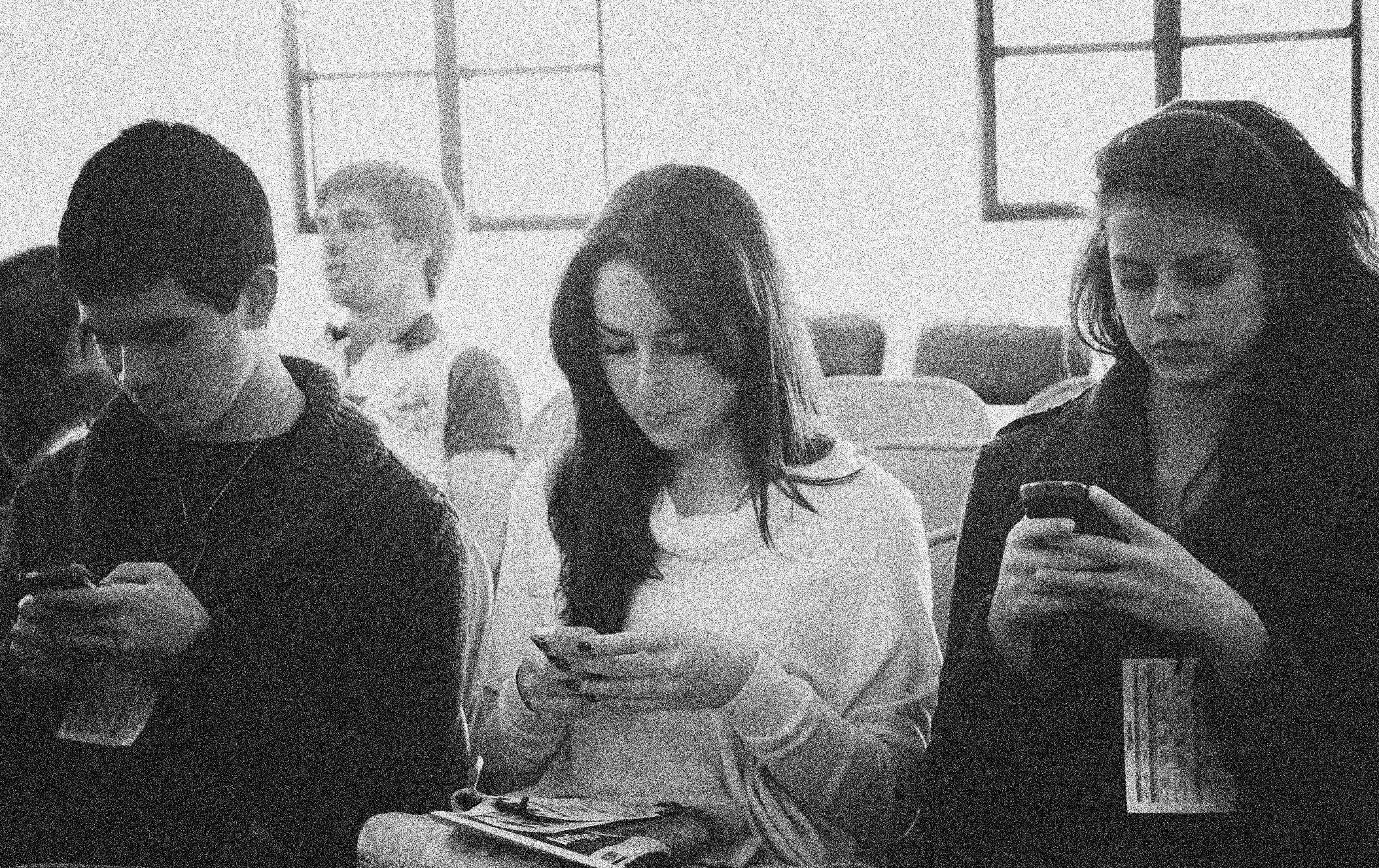
How disappointing then to consider that our understanding of leisure has only deteriorated as some of our least immiserated workers have labored hard to ensure the nearly universal distribution of quasi-magical technologies that are supposed to reduce drudgery and increase productivity and generally accelerate the arrival of a work-free utopia. Let us forget, for a moment, the obvious facts that drudgery has increased in what seems like direct proportion to the number of tasks our devices enable us to perform simultaneously, and that productivity seems to have decreased in similarly direct proportion to the number of people who have been convinced that multi-tasking is a thing. Even if so-called artificial “intelligence” really does deliver a world without alienated labor, by delivering a world without any labor at all, it is already adding here and now another layer to the same world of frantic boredom built on the back of the smartphone and the social media platform. And to the extent that we actually do have less bad work to do (which for some people in some ways is true), we all are spending more and more of our “free” time working (scrolling, swiping, producing this eerie new commodity called “attention”) onscreen, entertaining ourselves by making other people richer and ourselves less free. Perhaps one reason it is easier than ever to imagine the end of the world than the end of capitalism is that the most valuable corporations in history have managed to supplement and maybe even replace the false distinction between work and leisure with a new form of “leisure” which is actually a new kind of alienated work, and is therefore what we might call “alienated leisure.”
Alienated leisure is as good a term as any for the peculiar experience of living in the “attention economy.” Indeed, it is a better term than most, because it is not swaddled in the kind of therapeutic claptrap that invariably, in the service of mental health, leads to calls for more mental health care, as if the problem were in your head (sorry, in your brain: it’s certainly never your fault!) and not in the heads of the mercenary psychologists who deliberately addicted you to short-form videos. Nor is the term saddled by moralistic concerns about distraction and dissipation, as if it really were just your fault, when of course it is not, even if you can and should avoid succumbing to distraction and dissipation. “Alienated leisure” puts the focus where it belongs: on a material system that has spiritual effects, one of which is a diminishing capacity to be sufficiently offended by what is happening to our ability to choose what we do with the “eight hours for what we will” sought by the old labor movements, before the colonization of those hours by the builders of some particularly shiny new “labor-saving devices” that have saved very few laborers from their traditional fate.
Consider what alienated labor is, for Marx: it is labor marked by a series of forced separations. First, the laborer is separated from the product of her work, both in the simple sense that she does not own it, and in the more profound sense that it owns her, because others own it, and use it to dominate her life. Second, the laborer is separated from the activity of working, by being confined to the performance of one task in a series over which she has no creative control (as on an assembly line), a confinement that damages her physically or mentally or both, depending on the work in question. Third, the laborer is separated from other laborers, who are turned from companions into competitors and reduced to obstacles or tools in the service of her own private ends. Finally, the laborer is separated from her human nature, which—it must be emphasized—wants to labor, and for that reason hates to be alienated from her labor by those who profit by doing so.
The parallel to leisure in the attention economy is easy to see. The product of our most determinedly “unproductive” hours (for Gen Z, over 6 hours of captured attention per day) is used to generate massive profits that we do not share, and to enable pervasive surveillance. The activity of scrolling (or clicking, or whatever) is intensely piecemeal, by design: we are algorithmically sorted with godlike efficiency into various silos and echo chambers that cut us off from any context that might salvage our act of attention from the constant fragmentation (cat video follows live beheading follows stock tips) that has been quite helpfully characterized as a form of “human fracking.” It goes without saying that we are unprecedentedly isolated from all the other people with whom we are supposedly more “connected” than ever before in human history. And, most importantly, we are increasingly cut off from our natural desire to spend our “free” time doing something that is free—something that is active and creative, something that strives for coherence and depth, something that involves not “connection” (that is what machines do) but honest-to-god relationships.
Unlike most on the “Left” today, Marx certainly thinks there is such a thing as human nature (what else would our material circumstances be alienating us from?). Marx’s conviction that humans naturally want to work, and that when their work is self-directed it is less distinguishable from leisure (and conversely that true leisure takes work; Homer Simpson drooling at the TV is most certainly not at leisure) will only become more important and more subversive if capitalism in the twenty-first century keeps its promises to automate vast swaths of alienated labor while opening up vast new territories of alienated leisure to those lacking the special “reality privileges” apparently enjoyed by Marc Andreessen. False consciousness is a thing, but in some ways it is easier to become and remain aware of your alienation when what is alienating is a job you feel forced by necessity to take (especially if it is a poorly-paid shit job, or even a highly paid bullshit job, in David Graeber’s sense). It is harder to stay alert to the fact that you actually hate your phone, since after all you keep scrolling on it, and nobody is “incentivizing” you to do it by paying you for your time. How can it be alienating if it’s freely chosen? Is not that the definition of leisure itself: free time spent on “what we will”?
So we have been made to think. Only by redefining leisure as no more than the absence of alienated labor has it been possible to so alienate us from our leisure that even our free time now becomes one more form of alienation, refined within an inch of its life, sliced and diced and parceled out into profit-generating chunks of captured attention. And now, it is with some horror that we realize—if we can—that even if we are quick to nod our heads in agreement, we are less and less capable of viscerally feeling the attraction of Marx’s quaint vision of leisure as hunting and fishing and cattle-rearing and criticizing, not only because all of those activities strike us as far too much work, but because all of them require the sort of slow and luxurious attention that is itself no longer for us a simple pleasure but an offputting slog. The insidious triumph of digital capitalism is to have turned attention into something we literally pay to others. And what they give us in exchange is nothing less than a steadily diminishing capacity to enjoy ourselves without making them rich.
Adam Smith is a Professor of Political Philosophy and Director of the Honors Program at the University of Dubuque.
Loved this. Though I was surprised you didn’t run with Adorno’s ‘Free Time’ essay at all. He fucking nailed this, in my estimation.
Thank you! Freedom (from capitalistic attention capture) is just another word for *something better to do* -- or "our aspirations set our capacity for freedom."